December 10th

The Nutcracker, Clara, and the Mouse King

More about nutcrackers: In 1816, a German writer named E.T.A. Hoffmann became enchanted with the nutcrackers being made in the Erzgebirge region of Germany. Hoffmann was a fantasy and Gothic horror writer. In 1816 he decided to write a story about a nutcracker, a girl named Clara, and the king of all the mice and what happened one Christmas Eve. He called it “The Nutcracker and the Mouse King.” Though intended for children, the original story had some scary, maybe even creepy parts. In 1844, Alexander Dumas re-wrote the story to be more child-friendly. This version inspired Pyotr Iliych Tchaikovsky to compose his very famous ballet, The Nutcracker, which premiered in 1892. Though it is a cherished tradition now, it gained popularity slowly. The first performance outside of Russia was in England in 1934. It premiered in the United States in 1944 in San Francisco, and in Australia in 1963. By now, the ballet is well-known and has become a tradition in many cities during the month of December. The music is a familiar staple of the Christmas season. It is also one of the reasons that nutcrackers have become popular worldwide.

When I was about 7, I began taking ballet lessons. I very much wanted to dance in The Nutcracker but had to wait until my second year. I wanted to be Clara but wasn’t old enough – Clara is a role that is usually done by girls between 11 and 14. The closest I got was to be a cat. I wore a black and white leotard with silver sequins on the front, a black tutu, and a pair of brand new pink ballet slippers. I also got to have very glamorous glitter eye shadow and glitter in my hair. I was on stage for about 2 minutes in only one matinee, which was really a student recital for selected portions of the ballet and practice time for the orchestra. None of this really mattered – with my costume, the lights, the music, and an audience (mostly parents) I felt like a real ballerina! It was a memorable experience and for the next couple of years I was certain I would be a dancer. This was replaced by an obsession with horses, camping and backpacking, and bowling. Yup – even won a trophy.

December 9th

Mix and Match Nutcracker has been a favorite ornament over the years. It is the one most often removed from the tree because it is great fun to mix up the heads and bodies of the four different nutcrackers. The first actual nutcrackers were simple mechanisms for-you guessed it-cracking nuts. Way back when if you wanted to eat nuts you had to crack them open yourself – no such thing as buying them in a bag or a jar. The tradition of the Christmas nutcrackers that we are familiar with began in the late 17th century in the Erzgebirge region of Germany which is a mining area. In the winter it would often be too cold and snowy to work in the mines so, to keep busy, the miners turned to whittling and carving wood from the thick forests. Utilitarian nutcrackers became figures of all sorts and were prized as gifts. Kings and soldiers were very popular then, as they are today. They gradually became associated with Christmas because they were most often made and exchanged in the winter. Eventually, they became so popular in other parts of Germany that a new industry – nutcracker production – became an economic mainstay of the region, allowing the nutcracker to spread to other countries in Europe. American soldiers returning to the United States often brought home nutcrackers, making them popular in the US and a symbol of the Christmas season. Though the early nutcrackers were utilitarian, most nutcrackers made today are made as decorations and do not actually crack nuts.

While we were in Germany, we replaced our inexpensive American nutcrackers with several very nice ones that were made in the Erzgebirge region. We have two Saint Nicholas, 1 large and 1 medium, and 3 soldiers, small, medium, and large. We thought we would have a favorite one, but we don’t. We like them all and enjoy putting them on our fireplace mantle during the Christmas season.

December 8th

Layden was the Brigade Chaplain for the 4th Brigade Combat Team, 10th Mountain Division. Most of his time in this assignment was spent on a 15-month deployment to Iraq, November 2007-January 2009. This particular period is called The Surge, and was a time when troop presence in Iraq was increased. His unit was stationed outside Saudr City, a suburb of Baghdad, at Forward Operating Base(FOB) Loyalty , which at the time was a dangerous place to be. Sarah, of course, did not go with him. Instead, she stayed at Fort Polk, Louisiana, our assigned duty station. The closest family was about 7 hours away and none of our children were living with us at that time, so it could get pretty lonely. Lucky for her, she had good friends – some near, some far – that offered lots of support and encouragement. Thanksgiving of 2008 two of her friends, one in Vermont and the other in Massachusetts, invited her for the holiday. This seashell garland was a gift from the friend who lives in near Boston. Each fall, she goes to the beach and collects shells which she strings with beads and makes into garlands. That year, she took Sarah with her to gather shells on a cold Atlantic beach, the waves winter green and frothy. Her friend made a garland with those shells and sent it for Christmas. Every time it goes on the tree, we think of good friends who knew how to lend support during a difficult time, and of our gratitude that Layden was able to return home sound in mind and body. Both of these blessings bring great joy.

December 7th

Today is the 2nd Sunday of Advent. In general Protestant religions, Advent Sundays anticipate the weeks before Christ’s birth through worship services focused on the events preceding Christ’s birth, including reading scripture, singing Christmas hymns and carols, and lighting candles – one for each Sunday arranged in a wreath (flat – on a stand or table) and one large candle in the center, the Christ candle, for Christmas Eve.  Each week highlights a theme: Hope (Week 1), Peace (Week 2), Joy (Week 3), and Love (Week 4). Participating in these services was one of our favorite parts of serving in the Chaplaincy.

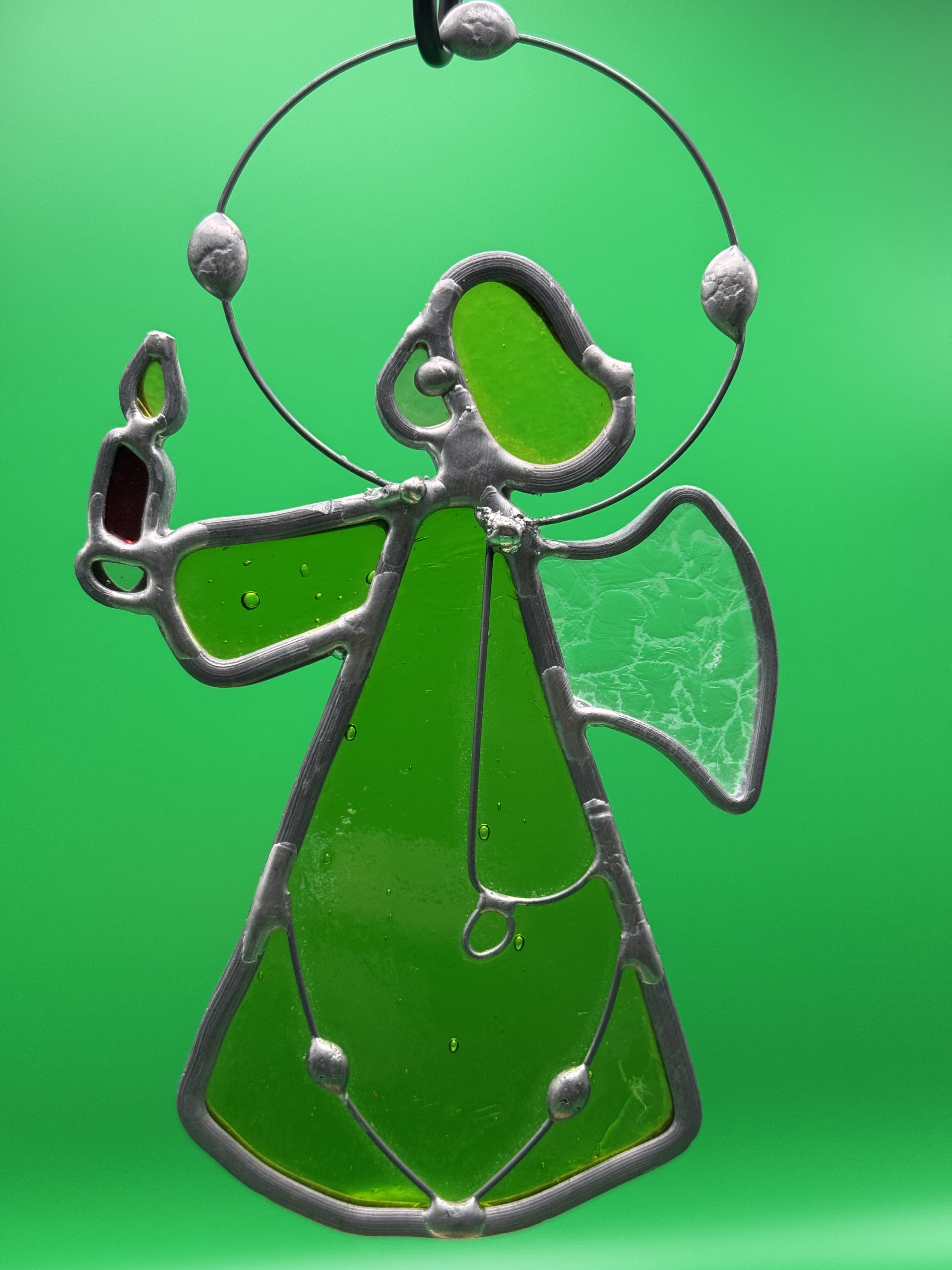
This angel carrying a candle is made of stained glass by an artist named Salli Hapner. Salli had a workshop at a small, charming amusement park called The North Pole, located near Colorado Springs, Colorado. Sarah first went to the North Pole when she was about eleven. Workshops at the North Pole are set up so that visitors can watch the artisans at work. Sarah was fascinated by the process of stained glass, often forgoing rides on the carousel or ferris wheel to watch Salli work. When she saw this angel, she really wanted it. The price was $2.oo. Though that price seems low today, it was equal to about $18.00 in 2025 money. At 25 cents a week for allowance, that was a long time for an eleven-year old to save! Many years later when we were stationed in Wiesbaden, Germany, Sarah was able to take classes in stained glass, something she still likes to do. She traces her interest back to those summer afternoons watching Salli turn bits of lead and glass into luminous treasures.

December 6th

December 6th is the feast day of Saint Nicholas, a 4th century early Christian bishop known for his generosity, kindness to children, and secret gift-giving. Many countries in Europe, such as Germany, the Netherlands, Poland, and Ukraine, celebrate this day. The most common way is for children to place their shoes near the door on the evening of December 5th, hoping that Saint Nicholas will leave them chocolates, fruit or nuts, and maybe a small gift. Some children leave a carrot or some hay in their shoes for Saint Nicholas’ horse. Sound familiar? This is because the Saint Nicholas of Europe is the basis for the Santa Claus of America. “The stockings were hung by the chimney with care in hopes that Saint Nicholas soon would be there.” is a line from the story poem “A Visit from Saint Nicholas” by Clement-Clarke Moore. First published in New York in 1823, it helped to popularize Santa Claus. We know the story best by the title “Twas the Night Before Christmas.”

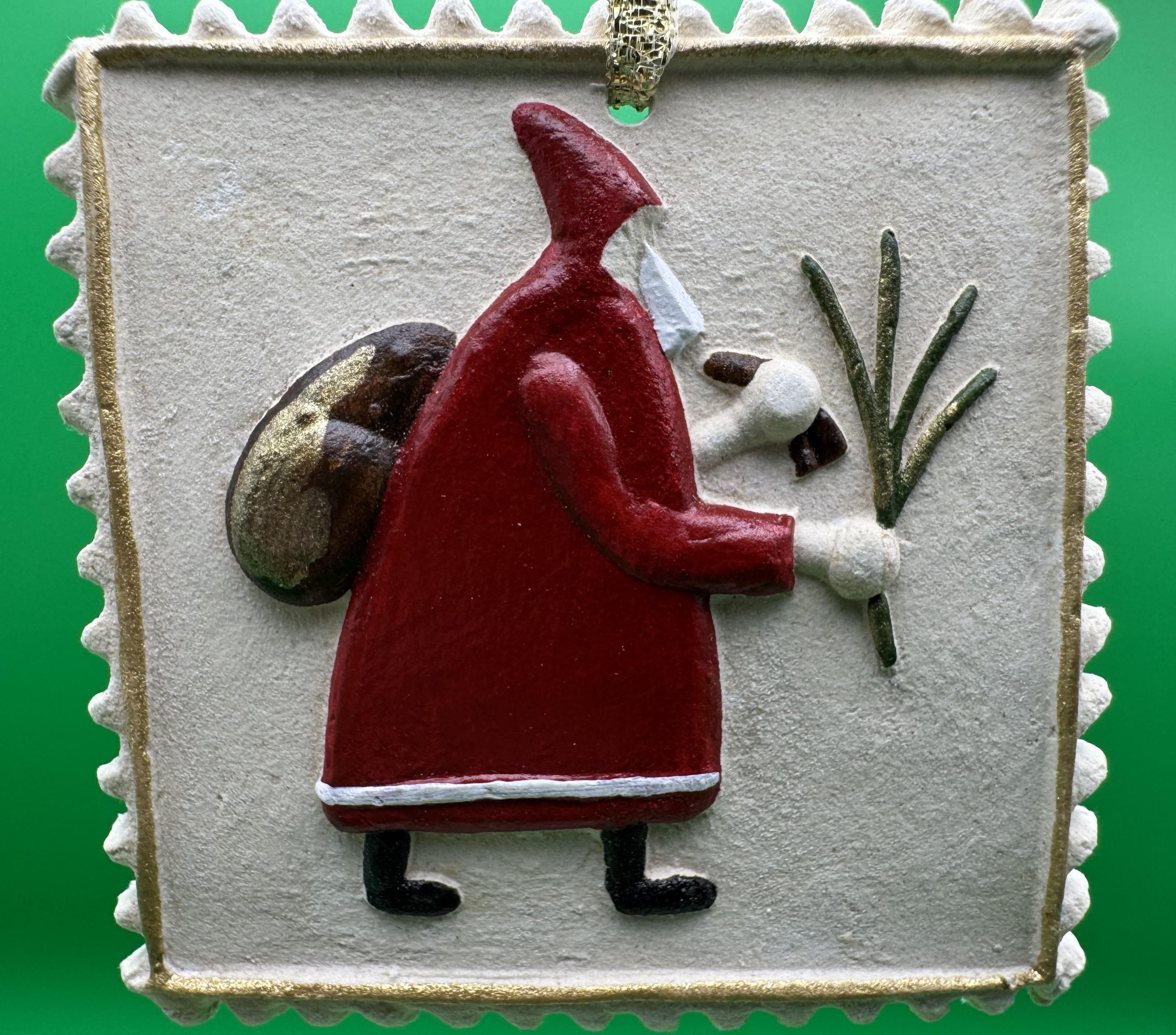
Saint Nicholas in Europe is usually thinner than our Santa and wears a red cloak and black boots. We found this ornament in Germany. It is made from salt clay using an old cookie press or cookie stamp, a wooden tool with a carved design to press onto rolled out cookie dough. Once all the dough was pressed with the design, it was cut around each one to make individual cookies, decorated with egg white “paint” tinted different colors, and baked. There are some bakeries in Germany that make cookies this way during the Christmas season. When we hang the ornament on the tree, we want one of those cookies!

December 5th

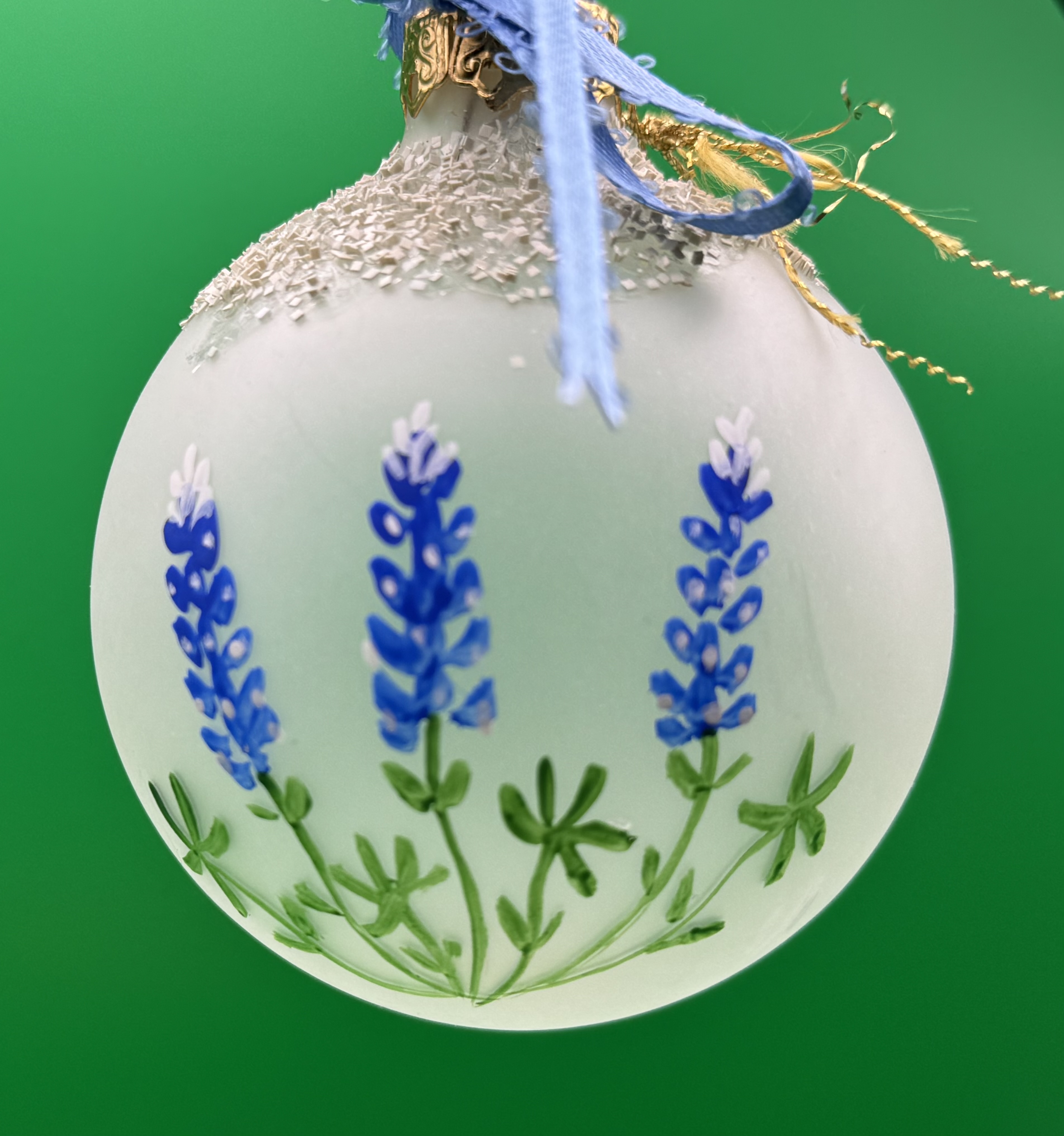
Fort Hood, Texas was our first active duty station after Layden was commissioned as an Army Chaplain in 1995. We were there for a total of 4 years. One year Layden decided it would be great fun to set up our video camcorder to record the kids opening presents Christmas morning. He put it on a tripod facing the tree. Of course we were all in pajamas – new because we always get new pajamas Christmas Eve. The boys had no problem with the whole thing. For us girls it was a different matter. We stayed well behind the camera as much as possible. When it was our turn to get a present we would dart in and back as quick as we could. The video was a combination of gleeful boys and blurry flannel nightgowns. Bluebonnets, the Texas state flower, don’t bloom in winter, but we are happy to have them bloom with good memories on our tree every Christmas.

Historical note – No cell phones back then that could take pictures, let alone videos. Mobile phones were slightly smaller than a regular phone handset and could make and receive calls. Just that – nothing else. Video capability on cell phones wasn’t commercially available until about 2002, and was not a standard feature of phones.

December 4th

A miniature gumball machine! The stand is actually made of metal and is heavy for its size. The dome is acrylic and filled with glass seed beads as the gumballs – very clever. It came from a Secret Santa gift exchange, so the giver remains a mystery. That is part of the fun of this whimsical ornament. Every year when we hang it on the tree we speculate who the giver might have been. We also remember being part of a good group of friends, which is an important component of military life. We were almost always stationed far away from home, missing parents, children, brothers and sisters. Friends became our substitute family.

December 3rd

Though dated 1980, this rocking horse wasn’t completed until 1981. It hung on the tree for Stephen’s first Christmas. I doubt he remembers the event because he was not quite 3 months old, but he does know that is his horse. He is patiently waiting for it to join the rest of his ornaments. When he got married, one of his gifts their first Christmas was all the Christmas ornaments that had been given to him over the years. Except this one – I am hanging on to it for a while longer because it reminds me of my first Christmas as a mother and how wondrous it was to have a baby of my own. It also reminds me of Mary and her first time as a mother which makes the Christmas story feel more personal.

The hat I made for myself. It had a pair of matching mittens which belonged to Stephen’ s Dad. These ornaments came as small embroidery kits. They were on sale because they were last year’s designs. I find it a bit odd that Christmas ornaments and decor have “trends” such as rustic plaid one year, bright red and green the next, metallics another, but they do. In this case, it worked in my favor. I was able to save money and indulge in one of my favorite hobbies – needlework. And, despite being designs from 1979, I don’t think they have lost one bit of charm or Christmas cheer.

December 2nd

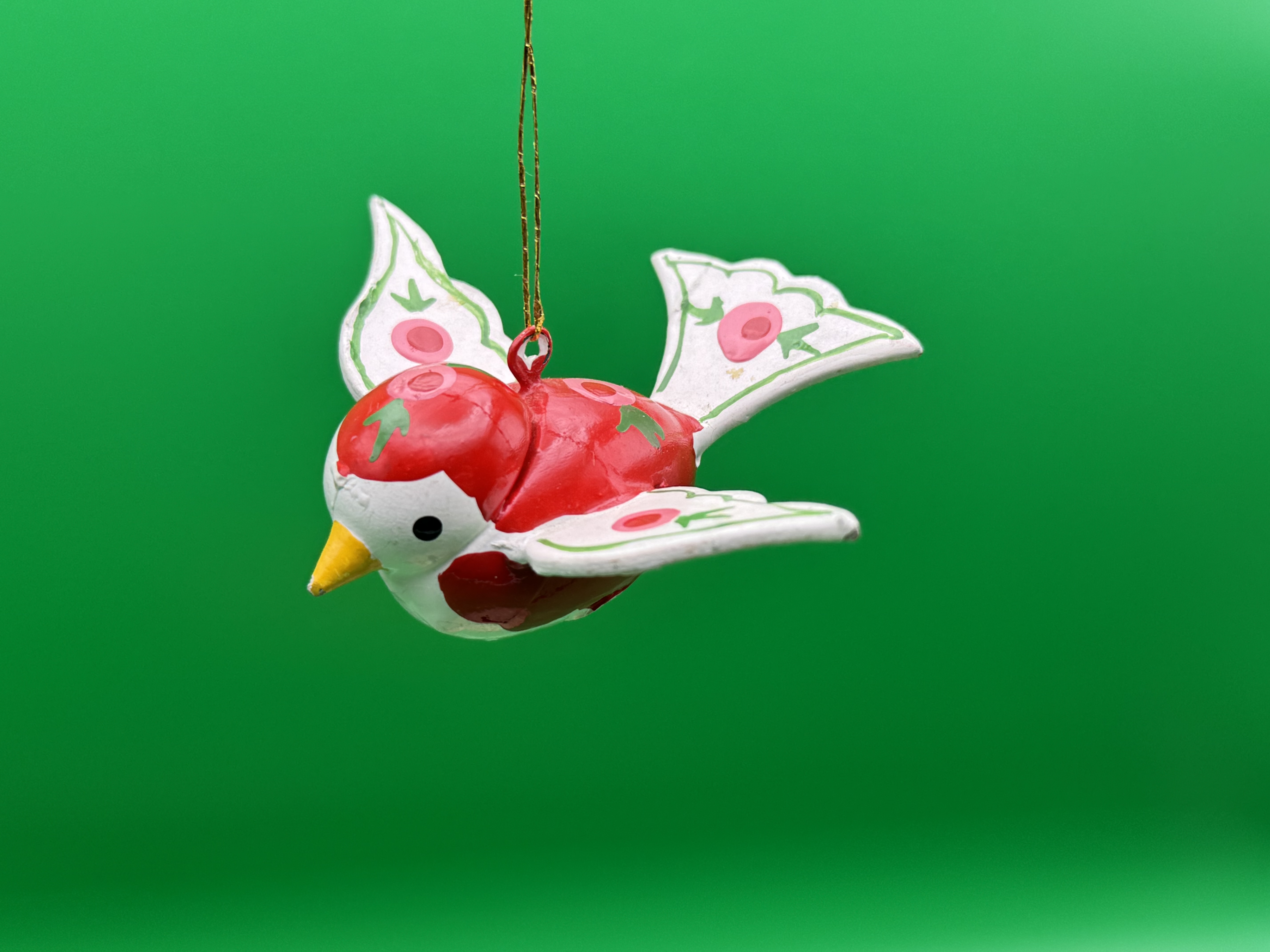
I don’t remember when I got this small (less than 2 inches beak to tail) hand-painted wooden bird, but I know I have had it since I was a little girl. We lived in an adobe house in Albuquerque, New Mexico. It had a big picture window in the living room and we usually put the tree in front of it. I remember my father, who was about 6’4″, would hang the bird at the tip of a high branch so I could imagine it was really flying through the wintry blue sky. Years later, my Mom sent it to me my first Christmas on my own. It was lovely to have a reminder of family and childhood. Over time, it has come to represent the kindness of my father and his recognition of the importance of imagination, and the wisdom of my mother knowing the comfort of the familiar in the midst of new beginnings.

December 1st

Christmas Mouse Decorating the Tree

‘Tis the season to decorate! This little mouse is a pre-fired piece of ceramic that I painted in the Craft Center at Brigham Young University in the summer of 1981. In those days, the Craft Center was located downstairs in the Wilkinson Center, around the corner from the bowling alley. It was also near the bus stop and passenger pick-up point – no for-pay ride sharing in those days, just carpools of friends or family economizing by commuting together. Very handy as I lived in Pleasant Grove, Utah at the time, a distance of about 24 miles. Not too far, but far enough to be happy to share the fuel cost, which was about $1.40 a gallon. I know that doesn’t sound like much, but in 2025 money that would be about $4.99

Anyway, the Craft Center was a great place to spend the time between my last class and my ride pick-up. The ornaments were about $1.00 each, which included the paint, the brushes, and the studio space. This was quite a bargain for young cash-strapped college students expecting their first baby in the fall. I made three ornaments over the course of about 6 weeks and they all hung on a fresh cut sparsely ornamented Christmas tree placed in the corner farthest away from the wood-burning stove. This is the lone survivor.