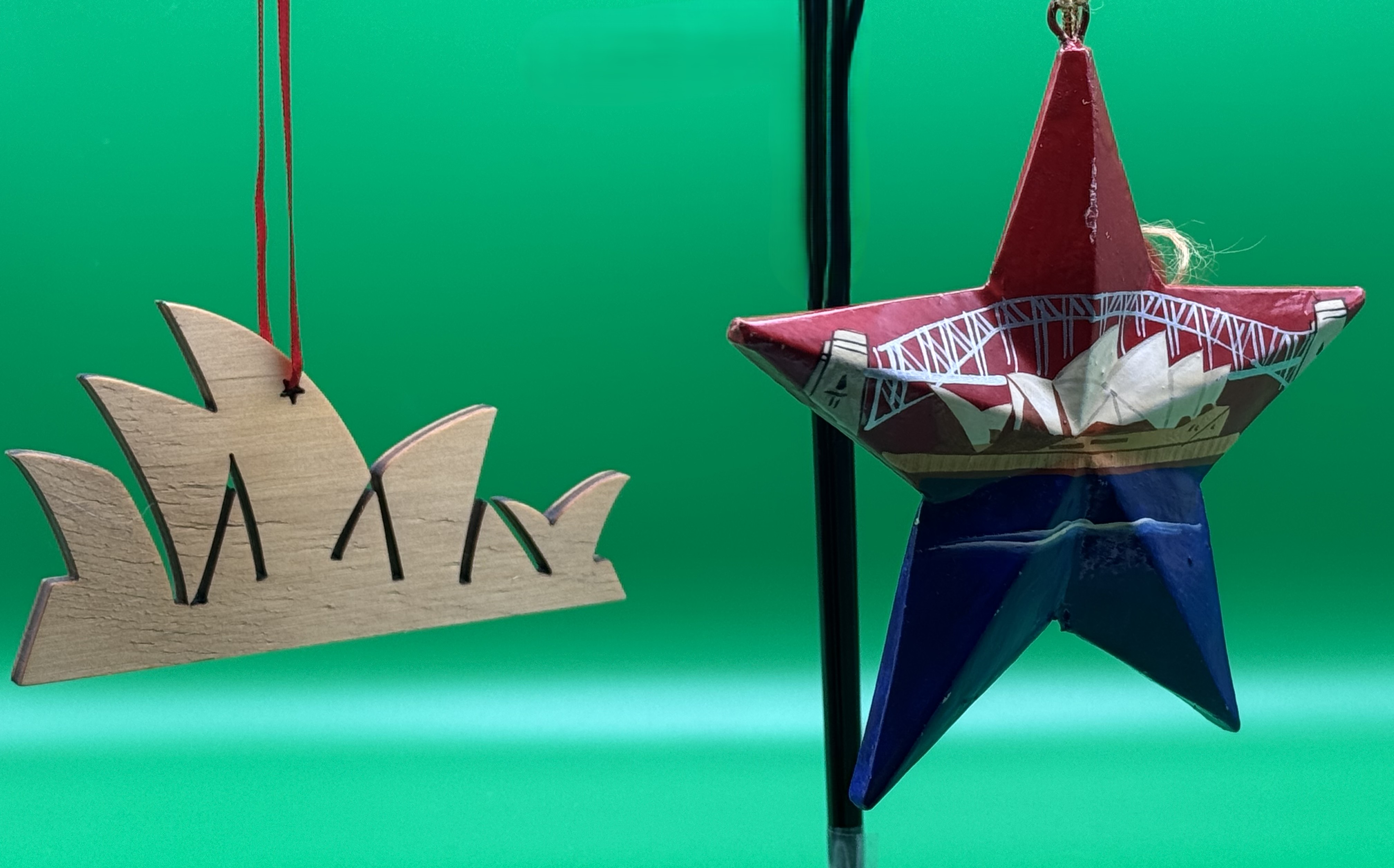
We got these ornaments when we visited our son who lives in Australia. These ones came from our first visit there, when he was living in Sydney. We got to do all sorts of things – visit the Sydney Opera House (one of my favorite buildings in the world), pet a koala, see kangaroos up close, and learn about all the deadly animals and insects that inhabit the Australian continent – there are A LOT. We were stationed in UIjeongbu, South Korea, so Australia wasn’t nearly as far to visit as it is from the US. We made our first visit in 2011. Since then, we have been back several times (not enough) and become acquainted with our two lovely, lively grandsons who live there. I am posting them on the 30th because this year, our son and his family are coming HERE! Today! To San Antonio to spend some time with us and welcome in 2026. What a treat!! We know how l-o-n-g the flight is, and how expensive. We appreciate the effort and are looking forward to seeing these wonderful people who live so very far-away.
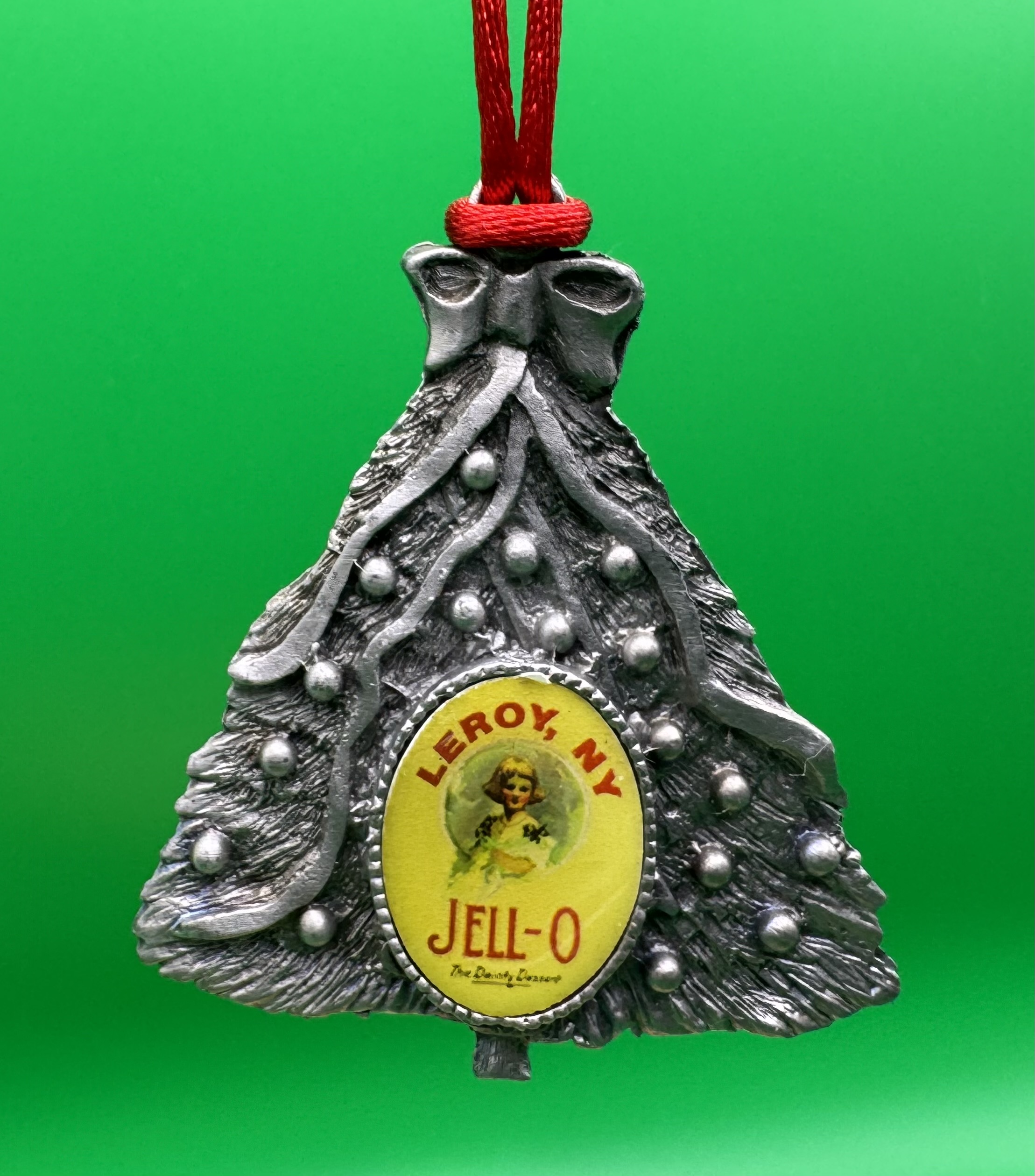
What? A Jell-O museum? Yup. A Jell-O museum. We encountered this place on a trip we made to Toronto to attend a conference for Layden. At the time, we were stationed at Fort Bragg, North Carolina. We decided it would be fun to explore the East coast so we decided to drive. Along the way, in up-state New York, we encountered a BIG sign welcoming us to Leroy, home of Jell-O, and inviting us to the Jell-O museum. We couldn’t pass that up. It was actually a very informative museum. I learned a lot about that ubiquitous, seemingly un-impressive dish often presented at church picnics and back-yard BB-Q’s. While Jell-O is a rather humble thing, it was also transformative in many ways for middle-class America, allowing any housewife the luxury of serving gelatine dishes, a privilege once reserved for the wealthy who could afford servants to do what was once a very labor intensive process. Here is a link if you want to know more: https://jellogallery.org/ When this ornament goes up on the tree, it reminds us not to underestimate what might seem ordinary or commonplace.
This small ceramic ornament is part of the Hallmark ornament collection. We got it because we had a brown dog named Ginger. We got her in Utah, moved her with us to Texas for our first full-time Army assignment, and then to Germany for our next one. She was a friendly, gentle Labrador/Weimaraner mix. Though not as clever as Solomon, she was much wiser. She had a knack for responding to people’s moods and feelings. We knew she was responsive to family, but until an incident in a German hospital, we did not know this extended to others.
Germany is a very dog-friendly country. It is possible to take dogs many places we usually do not in the US. Many restaurants, public transportation, and even hospitals welcome a well-behaved dog. We found this out when Layden got a call requesting a military Chaplain to assist with an American woman who had been admitted to a German hospital. She was not doing well. We had been out on a walk with Ginger and the hospital was nearby, so we headed straight there. Layden got out of the car and the dog tried to follow. A hospital attendant noticed me putting her back in the car and asked if we were there to visit someone . I said yes. She let me know that it would be ok for me to take the dog inside. So, I did. We caught up with Layden who was trying to communicate with the woman. She was unresponsive to his efforts. When Ginger got in the room, she immediately sensed the sadness and promptly laid her head in the woman’s lap. Soon the woman was petting Ginger, and then talking to her, and eventually talking to the Chaplain. We brought the dog on subsequent visits. It made a huge difference in her recovery. After this experience, Layden would take Ginger with him when he made informal visits to soldiers, especially Sunday afternoons when he would visit the barracks. Ginger was a welcome addition for everyone, made many friends, and lifted many spirits. It doesn’t always require a PhD in counseling to have a positive impact on mental/emotional health.
These paper mache apples covered in a shiny glaze were an after-Christmas purchase – a plastic container of 20 on sale cheap. They look great on the Christmas tree and are perfect for hanging on the lower branches when you have a cat that likes to swat your ornaments. It turns out the dog liked them too. At the time we had a lovely Airedale Terrier by the name of Solomon. Though not often wise, he was very clever. One day I happened to notice one of the apples in his dog bed. I figured he picked it up after the cat swatted it off the tree. I hung it back up. The next day there were two apples in his bed. I hung those up. An hour later they were back. Curious, I positioned myself to be able to see the tree while going relatively unnoticed. Pretty soon, Solomon came over to the tree, chose an apple, put his nose under it, lifted it off the branch and carefully carried it to his bed. Like I said, a clever dog. It became a bit of a ritual – hang the apples, retrieve the apples, hang the apples, retrieve the apples. These are the last few we have left. They are not all as shiny as they once were and they have tooth marks. When we hang them on the tree we think of that dog with great affection.
One of our favorite things in December is sending and receiving Christmas cards. Not digital ones, but real ones, with stamps, pretty or festive designs – maybe even with glittery snow – and perhaps a newsletter or photo enclosed as well. Christmas cards became the way we kept in touch with friends we made in the military, giving us the chance to continue friendships despite military transfers. We still have quite a few on our list and love seeing the handwriting and reading the messages.
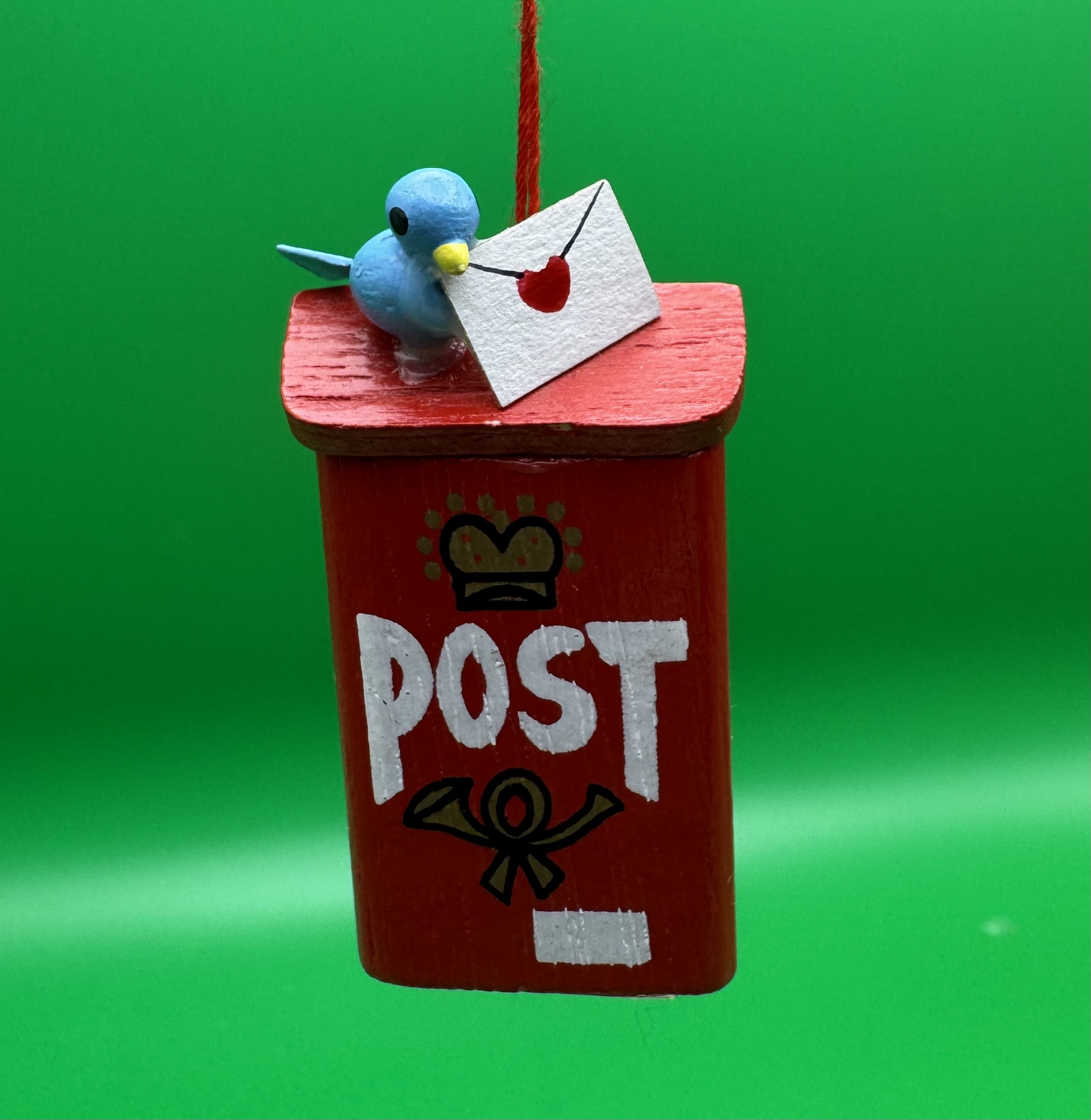
This tiny wooden post box (or mailbox) ornament is another German Christmas Market find. Though that is where we came across it, this is not a German post box. It is a Danish post box. The particular shade of red is from the Coat of Arms of the House of Oldenburg, a line which includes the royal family. This red color was also used for the postmen, making them easily identifiable and also conveying their authority. The crown indicates ties to the monarchy, giving the message that this is an official post box. The horn is emblematic of the official postal service. These elements have been standardized on the boxes since the 1860’s. At one time, these boxes could be found all over the city of Copenhagen, the capital of Denmark. It was hard to find a street that didn’t have at least one. They were also conveniently placed in smaller cities and towns, and were used often. Alas, the red post box is being phased out. Physical letters, cards, etc. have declined about 90% since 2000, with many boxes being little used. Soon the post box will be a relic found mostly in museums. This is a bit sad for many residents of Denmark, and for Layden too. When he was living in Denmark in the late 70’s there was no email, no facetime or Messenger, no texts, and overseas phone calls quite expensive. Sending a letter was economical – in 1977 the cost of a first class US stamp was 13 cents, and an international stamp was 25 cents for the first ounce, going up a few cents as weigh increased. Rates were similar in Denmark, and Layden relied on those red post boxes to keep him connected to family and friends in the USA.
Denmark is not the only country facing the decline of physical mail – most countries are seeing the shift to fast, cheaper digital communication. Mail is no longer the cheapest way to communicate. A regular US stamp in 2025 is 78 cents, and overseas mail starts at $1.70 an ounce. Despite this, we are doing our part to keep the tradition going – long live Christmas mail!
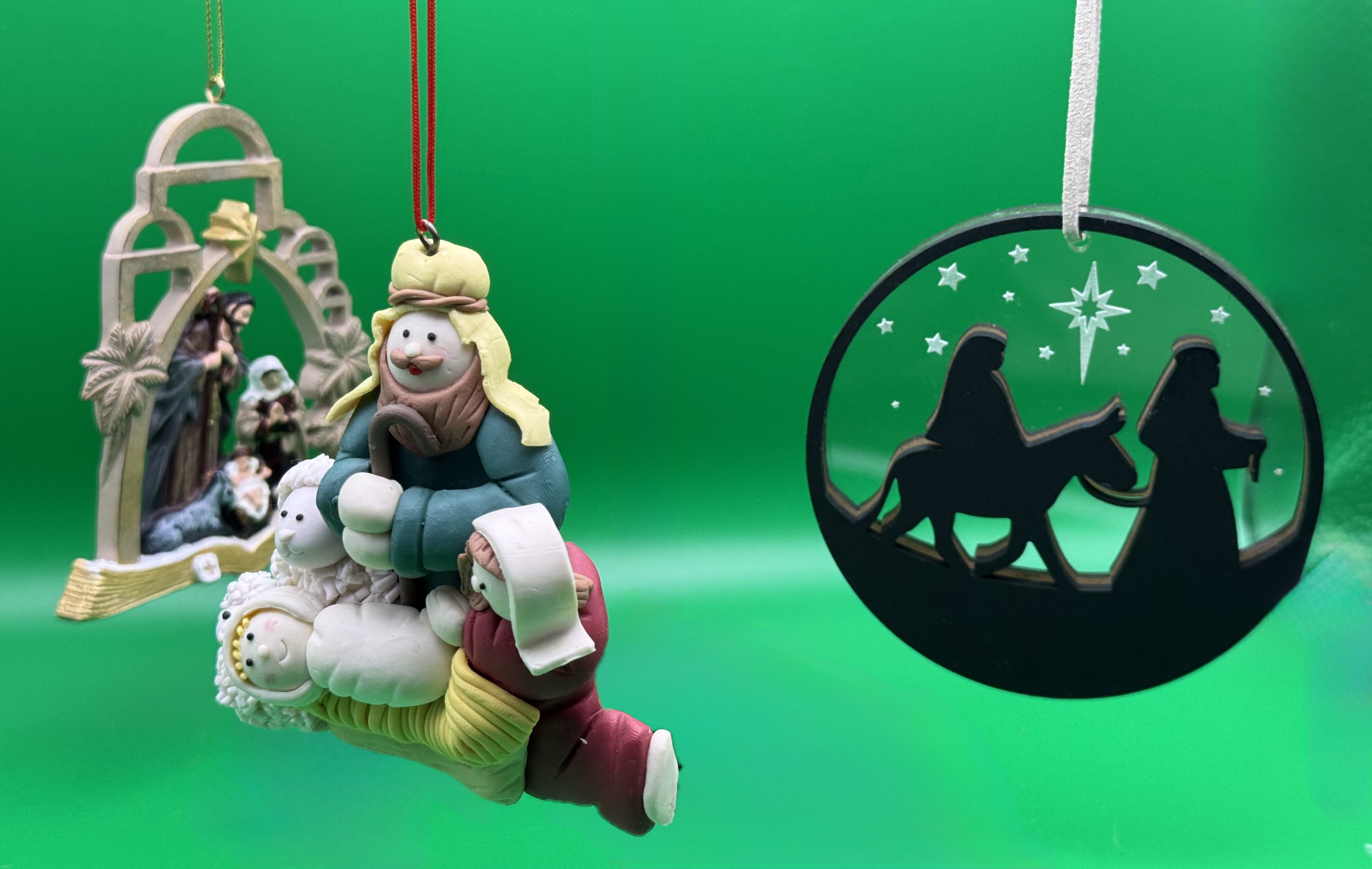
It is here! Christmas Day!!! For some of you, the morning may have started off early with eager young children anxious to see what has been left for them under the tree. For others it may have gotten off to a more leisurely start. However the day began for you, I hope that somewhere in the midst of the celebration, you take a moment to remember the reason we have Christmas in the first place. These ornaments came from various congregants over the years – seems a suitable gift for a Christian Chaplain. They remind us that the core of this holiday is a birth day, long foretold, anticipated, heralded by angels, marveled at by shepherds, honored by wise men. It is meant to be a day of joy, of connecting with loved ones and with heaven. I hope these things happen for you.
Maybe, though, this is a hard day. Perhaps there is loss, grief, disappointment or isolation. These aspects of the human experience are never easy, and the holiday season may increase the sharpness. I hope that you will encounter a measure of peace, that you might feel seen or heard. And I hope that all of us will be on the lookout for the stranger who might need room at the inn.
Perhaps this isn’t a religious holiday for you. That’s ok – we all find our own path for meaning. I invite you to be glad for those of us who celebrate this day as a holy day and take a moment to reflect on the stories and beliefs that add meaning to your life. Whatever this day is for you, may it be wonderful.
MERRY CHRISTMAS
Note: This has been a lot of fun, so much so that I am going to continue til the end of the month, so check back for more ornaments.
Well, here it is – Christmas Eve! Santa’s big scene. The night before Christmas, though generally through my house it is not as quiet as a mouse. It is often a busy day. This was especially true for the years when Layden served as a Chaplain.
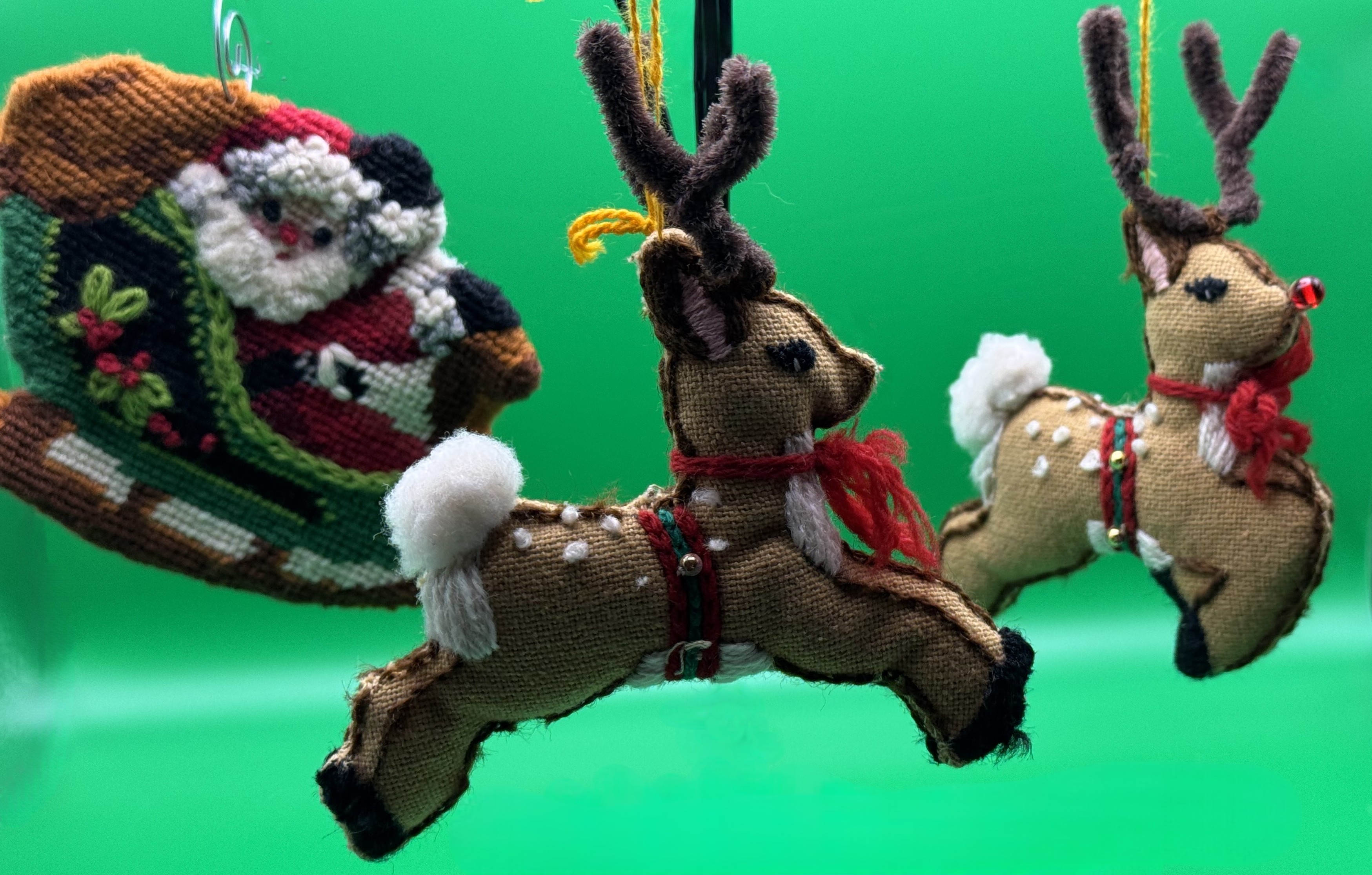
Christmas is an interesting mix of pagan and religion, of secular and spiritual. There is a lot of fun to be had with Santa Claus, the anticipation of waking up Christmas morning to gifts that magically appear under the Christmas tree, the songs and stories inspired by Saint Nicholas. I enjoy the traditions associated with Santa, which is one reason why I took the time and effort to embroider these Santa and reindeer ornaments.
But, there is also the other side of Christmas, the story of the birth of Christ, without which Christmas as we know it wouldn’t exist. As we served in the Chaplaincy, the time leading to Christmas was filled not only with Santa, decorations, and Christmas cookies, but also with the Advent Sunday services, prayers at the lighting of the on-post Christmas tree, toy drives, food collections, and other community events. My favorite of these was the Christmas Eve Candlelight service, held of course, on Christmas Eve. It was usually a fairly short service, focused on the telling of the birth of Christ, a brief sermon to remind us of the deeper meanings of the season, and singing Christmas carols. At the end of the service everyone received a white candle with a paper collar (for catching the drips of which there were a lot). The chapel lights were turned off . We sang Silent Night as the ushers walked down the nave lighting a candle at the end of each row, the light then being shared with the next person and the next, until the chapel was filled with gentle flickering light. It was lovely. It was peaceful. It was a time to reflect. But, most of all, it was a reminder of the power of light in the darkness, and the magic that happens when we share our light with each other.
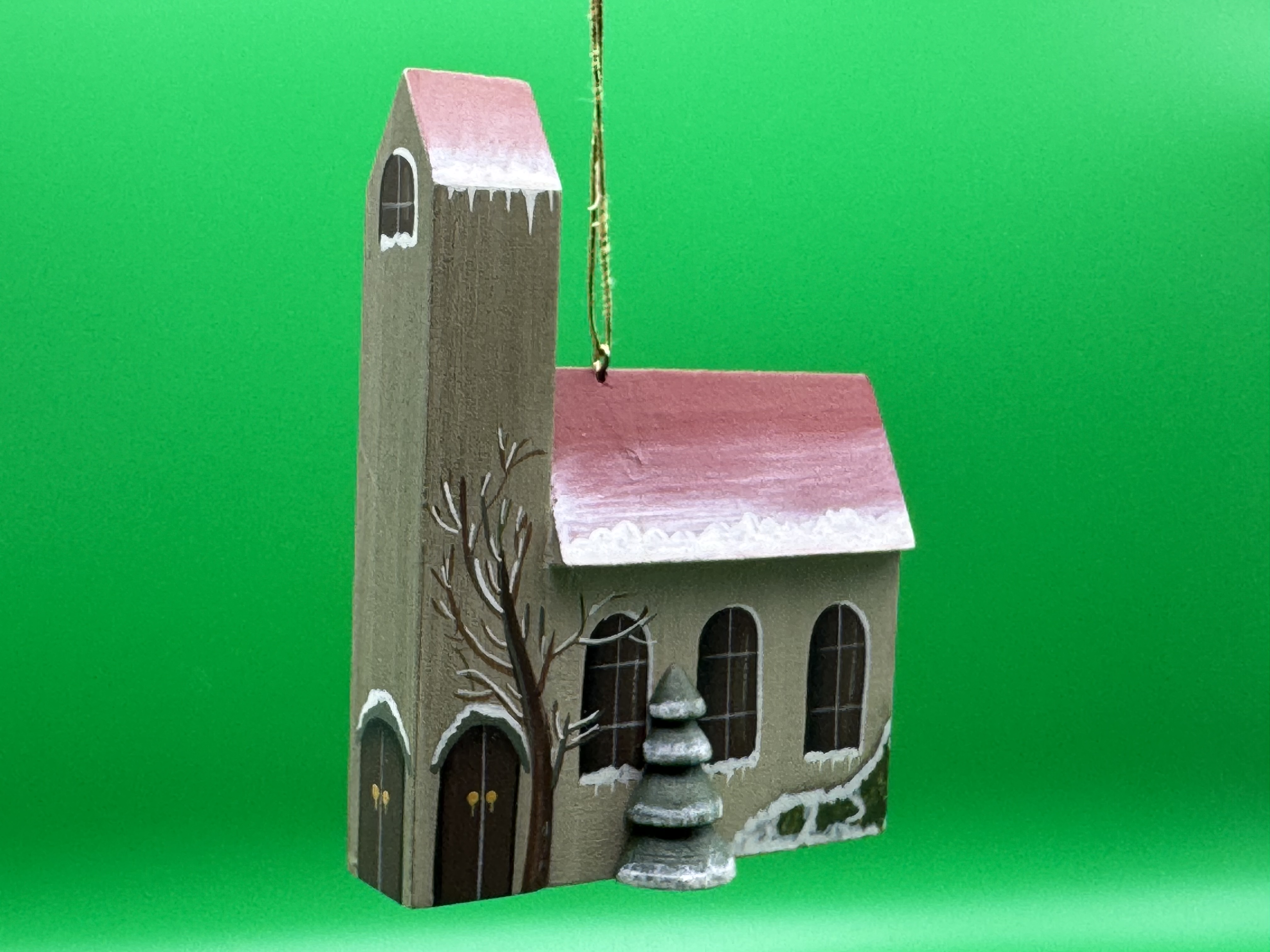
This ornament that we found at a German Christmas Market looked remarkably like the chapel on post in Mannheim where we were stationed at the time. When we hang it on the tree it reminds us to slow down, remember, and share the light.
When I was in college, one of the ways I earned money was to sell Avon. This is when it was a door-to-door operation. About every two weeks I would get a stack of the current catalog along with samples of new cosmetics and other products. I would walk my assigned area, giving out catalogs, sharing samples, and showing specialty products which during the Christmas season always included an ornament. I would take orders, submit them, wait for the shipment, and then deliver the orders along with the newest catalog. I got paid about 40% percent of the total dollar amount I sold. From that was deducted catalogs and products for demonstration, which I had to pay for myself. Even with that, I was able to make a reasonably fair amount of money – slightly better than minimum wage – while having complete flexibility to schedule my work hours around my classes. It was actually quite enjoyable to meet my customers and get to know them over time, a much more personal experience than shopping on line.
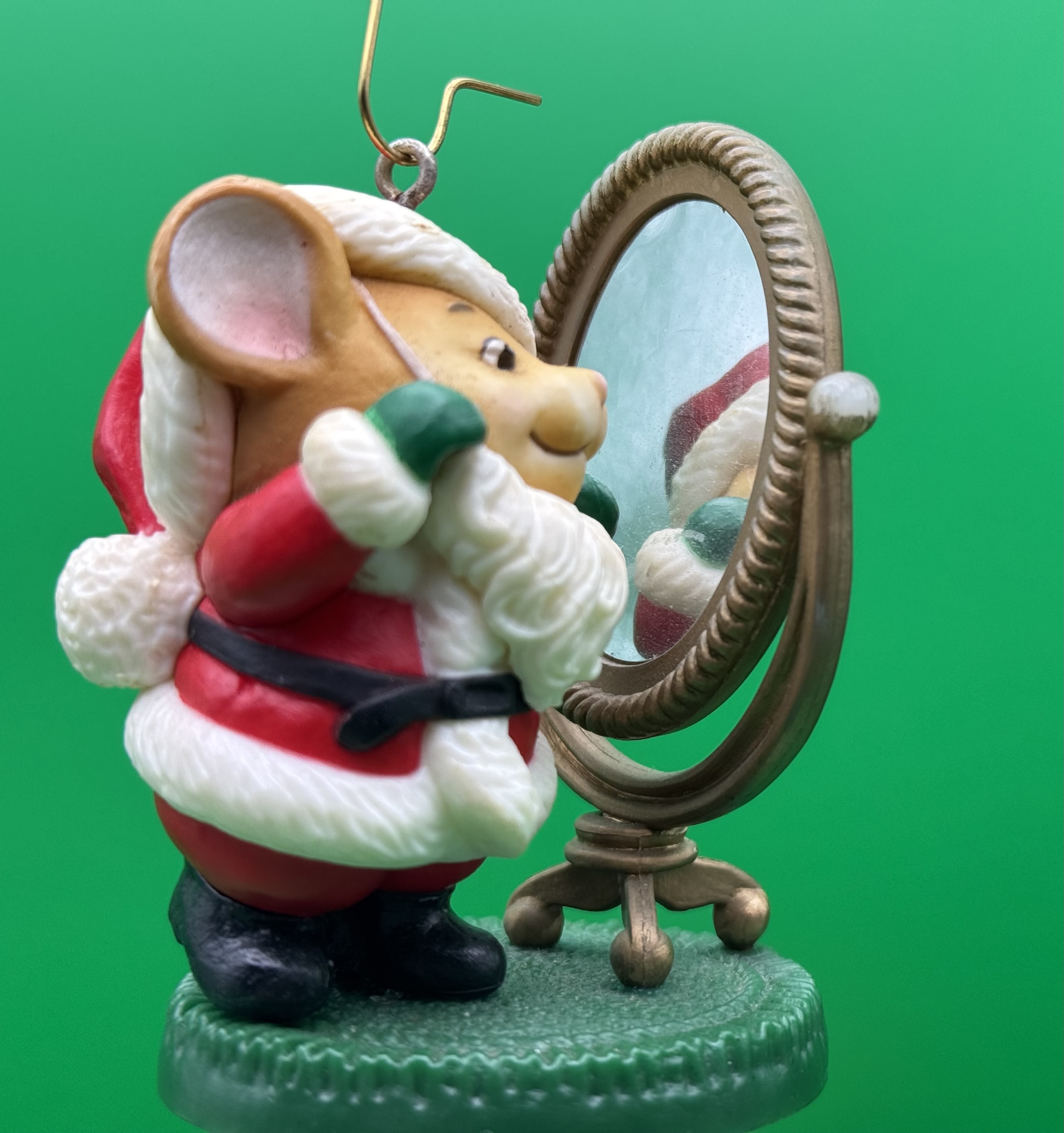
This ornament was issued in 1982. It originally sold for about $3.00, in keeping with the Avon promise of affordable quality. In today’s dollars, that would be about $10.00, which is what this ornament, now a collectible, sells for on platforms like eBay and Etsy. It has long been a favorite, especially with the children, who were intrigued by the whole idea of the mouse in the mirror.
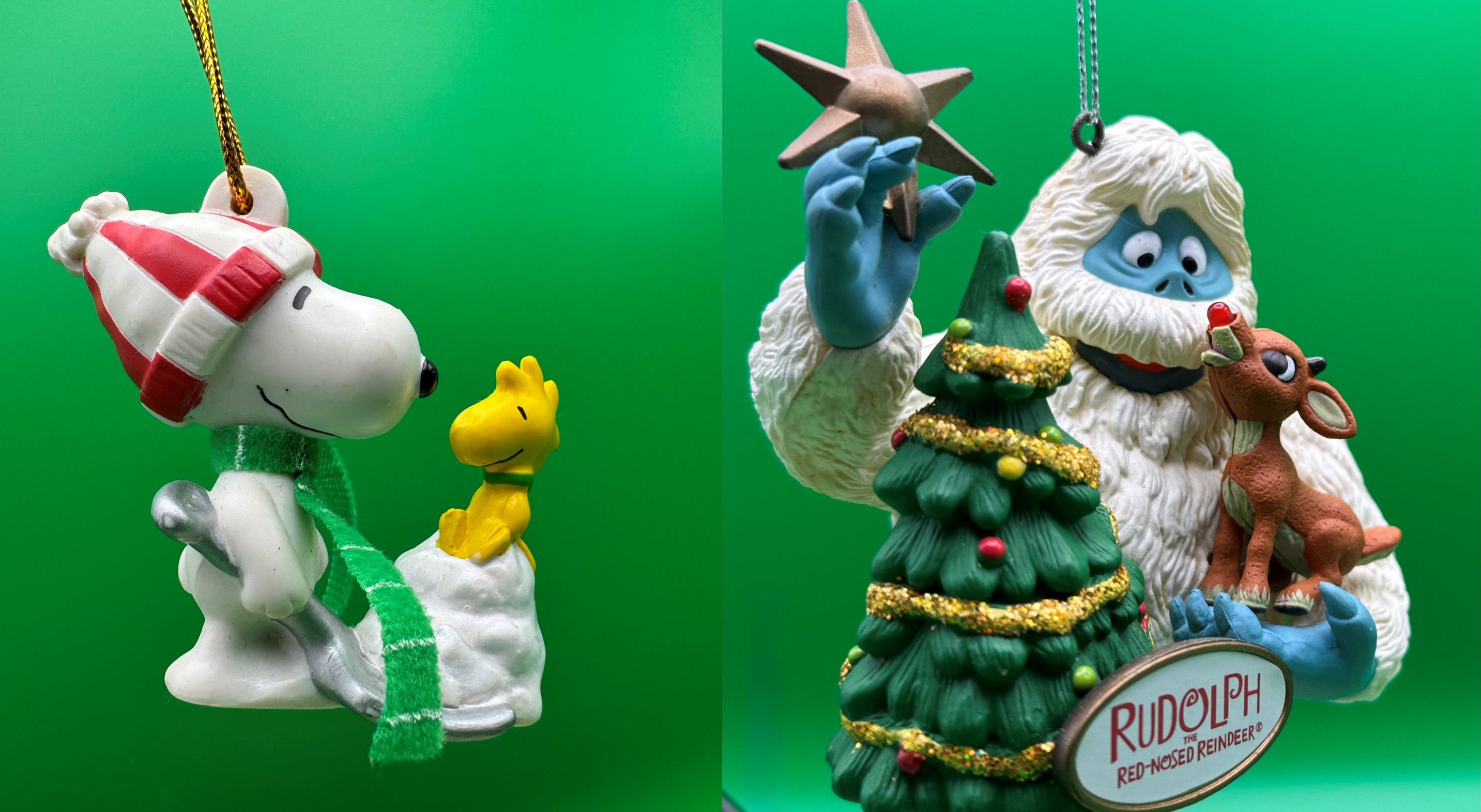
When Layden and I were young children we would wait impatiently for the Christmas specials to air on TV. At the time there was no such thing as a DVD or a video tape, and certainly no streaming. Most of the country had 3 television channels: ABC, CBS, and NBC, and usually a local carrier for a Public Broadcasting station. Christmas specials aired once a year on one channel, and if you missed it, well – you would just have to wait til next year. Two of our very favorite Christmas specials were A Charlie Brown Christmas and Rudolph The Red-Nosed Reindeer.
Rudolph first aired on December 6th, 1964 on NBC. It was made using Animagic, which at the time was a complex and sophisticated process of stop-motion animation. The filming was done with puppets and shot frame by frame, moving the puppets just slightly each frame to create the illusion of movement. The special took 18 months to complete. The show was an immediate success and has become a holiday classic. Songs from the show, such as Holly Jolly Christmas, have become part of the Christmas repertoire.
The Charlie Brown special first aired on CBS December 9th, 1965. This whimsical yet serious show has become a beloved Christmas classic. In this story, Charlie Brown has his usual string of challenges and failures, but the story is redeemed when he learns what Christmas is all about. Made using traditional cartoon animation with a jazz soundtrack by Vince Guaraldi, it was a low-cost production, completed in about 6 months. The show was initially rejected by CBS who worried it would take away from their regular viewing audience. However, the Coca-Cola company, who commissioned the show because they wanted a family-friendly Christmas special, also sponsored the show and persuaded CBS to take a gamble. It was an instant success and by 1968 was being aired internationally.
These two ornaments remind us of the anticipation we felt during the Christmas season, which certainly seemed much longer when we were children than it does now.
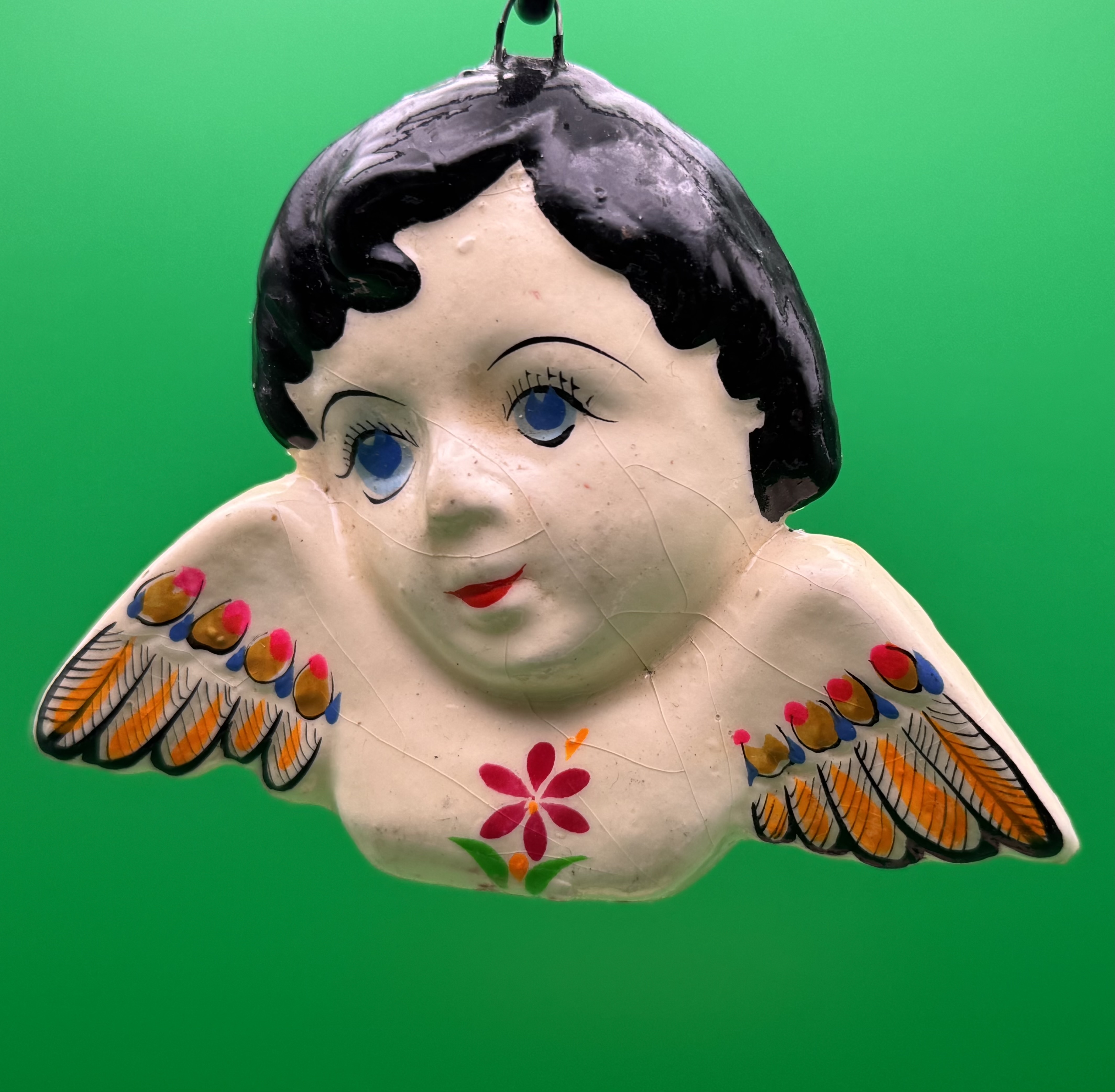
Today is the 4th Sunday of Advent, represented by the angel, and also the Winter Solstice, represented by the sun. The angel is a clay-fired ornament with white glaze and hand-painted details. Originally made in Mexico, I picked this up in Santa Fe, New Mexico at a shop called Jackalope Pottery. Years ago it was a quirky little shop tucked along Cerrillos Road that sold mostly pottery and other items imported from Mexico. Now it is a much larger store that carries a big inventory of multiple items, much of which is aimed at the tourist trade. I prefer the old shop with its cobbled-together rooms and cozy, welcoming feeling. This angel reminds me of a much less crowded and developed Santa Fe, and is a reminder that more is not always better – a good thing to keep in mind this time of year.
The sun is from the other side of the world. We found this in a shop just outside Bolesławiec (pronounced “Boh-le-swav-yets”), a city famous for blue and white Polish pottery. While we were stationed in Germany, Layden and I and several friends piled into our mini van and made a long day trip to the city. It was a bit of an adventure because the pottery was gaining in popularity, which meant tour buses, which meant lots of people crowding in. We did our best to get to shops before or in between buses. It became a bit of a game which we called “Beat the Bus.” At the end of the day as we were headed home, we saw a shop that specialized in glass ornaments made in the traditional “Old World” fashion. These ornaments are made of glass blown in to molds. The insides are coated with shiny silver paint which adds depth and lustre to the designs painted on the outside. These are sometimes called mercury glass because the inside coating used to be made from silver nitrate – shiny but highly toxic. This sun got dropped once, breaking a few of its rays. We put cotton balls in the broken spot to resemble clouds. Now when we put it on the tree, we remember that sometimes unfortunate things happen and things are not always sunny, but that doesn’t mean we should give up.
Of interest: The Winter solstice marks the longest night and the shortest day and always happens near Christmas. It was a very important pagan festival, still celebrated in many places today. The occasion is observed in different ways depending on where in the world you are, but most include feasting, dancing, and merrymaking, all accompanied by a lot of light in order to beckon the sun to return. The tradition of burning a yule log is one solstice celebration that became part of Christmas tradition.