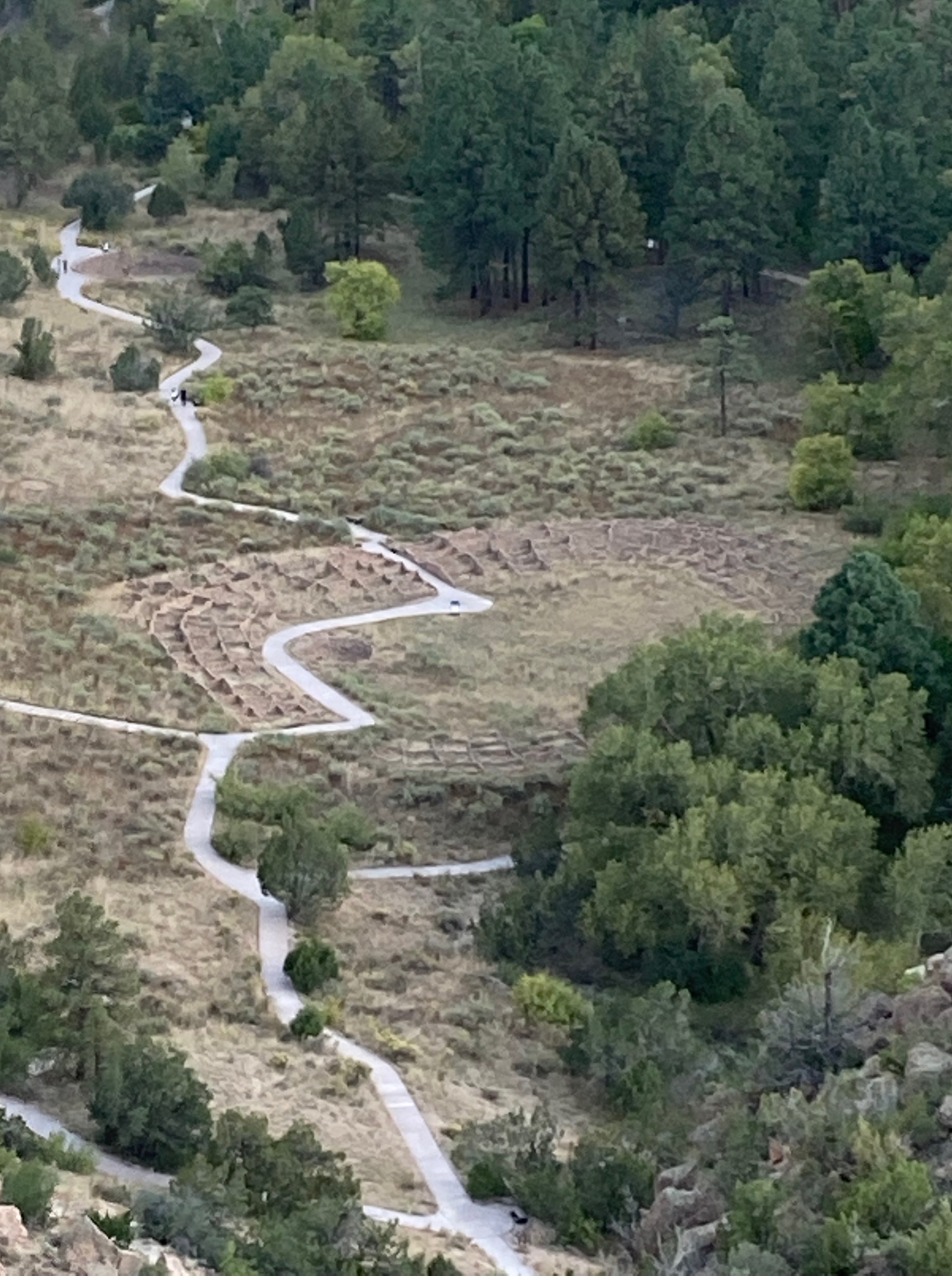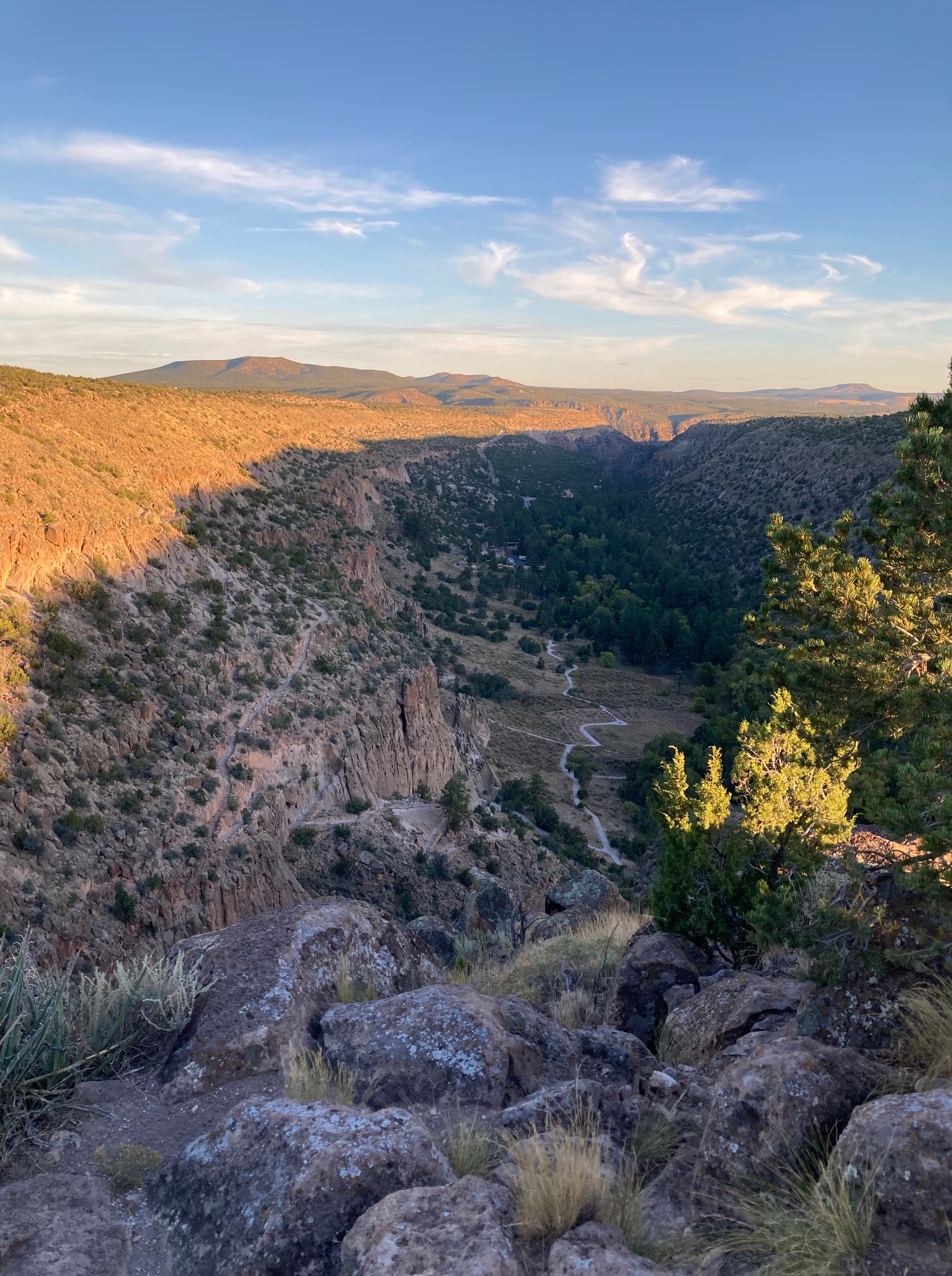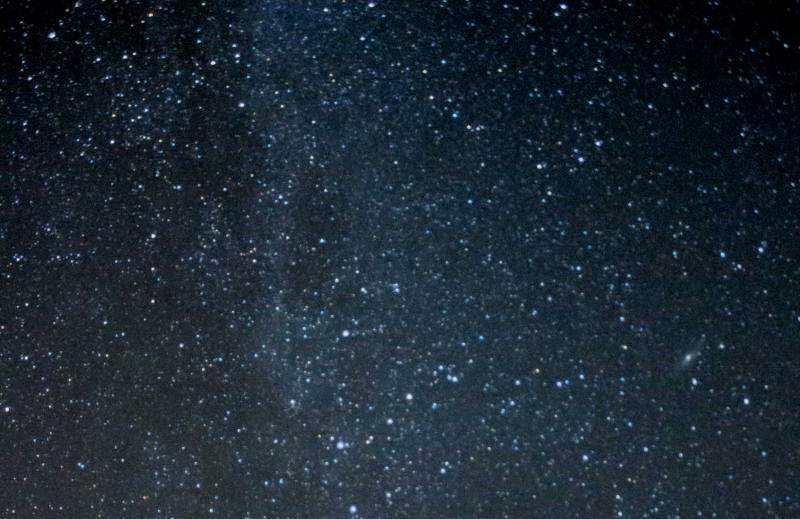
Fall has arrived on the Pajarito plateau. Aspens on the higher elevations of the Jemez mountains to the west and north are gracing the hills with brilliant spots of color. The grasses in the Valles Caldera are fading from greens to a variety of bronze and brown. Here in the canyon, where the walls provide shelter and hold a bit of heat from the sun, colors are just beginning to turn. The tops of the cottonwoods along Frijoles creek are burnished with a touch of yellow-orange. The aspen outside my casita are shifting from summer green to autumn gold. Nights are cool enough for a cozy fire. Though I can’t light one in my fireplace, smoke from the campground drifts down, bringing with it the distinctive spice of pinyon, a hallmark of cooler weather. This is a lovely time to be in New Mexico.
As mentioned in a previous post, I have an injury. It has had an impact on my time here in Bandelier. There are things here I simply can’t do, like climbing 140 feet of long ladders and stairs to Alcove House.
Alcove House, Bandelier National Monument (NPS photo)
It is the sort of activity that I would have had on a long list of must-dos, checking each one off and moving right on to the next one. I have often done that, especially when I was younger. It is fun. Exciting. Adventurous. Instead, I am learning to appreciate a slower pace. Alcove House is amazing. I have been there before and really wish I could go again. But instead, I stay at the bottom and enjoy the vertical view. I see delight on the faces of people who make it up and back. I notice how the light moves across the rock.
The interplay of light and shadow in the canyon is fascinating. The colors shift and change depending on the time of day or the clouds. It is wonderful to have time to observe and appreciate.
I have spent a lot of time on the nature trail, sitting on benches or walking slowly and observing. I listen to the chatter of the El Rito de Los Frijoles (Little River of Beans) which at its best is more of a sturdy stream than river. At this time of year is mostly a lively trickle. It is the main water source for the canyon and is one of the reasons early human habitation here was successful.
El Rito de los Frijoles
I also listen to the wind as it moves through the trees. The sound can be very different depending on the type of tree. Leafy deciduous trees, such as cottonwoods, rustle in the breeze. Evergreens like the ponderosa pine whisper or sigh. [There is a word for this – psithurism : the sound of rustling leaves or wind in the trees.]
I have had time to observe the hummingbird moth. It really does look like a tiny hummingbird.
Hummingbird Moth (NPS photo by Sally King)
Birds are plentiful and there are many types here, from large birds of prey like hawks to small ones, like the white-breasted nuthatch, one of my favorites.
White-Breasted Nuthatch (NPS photo by Sally King)
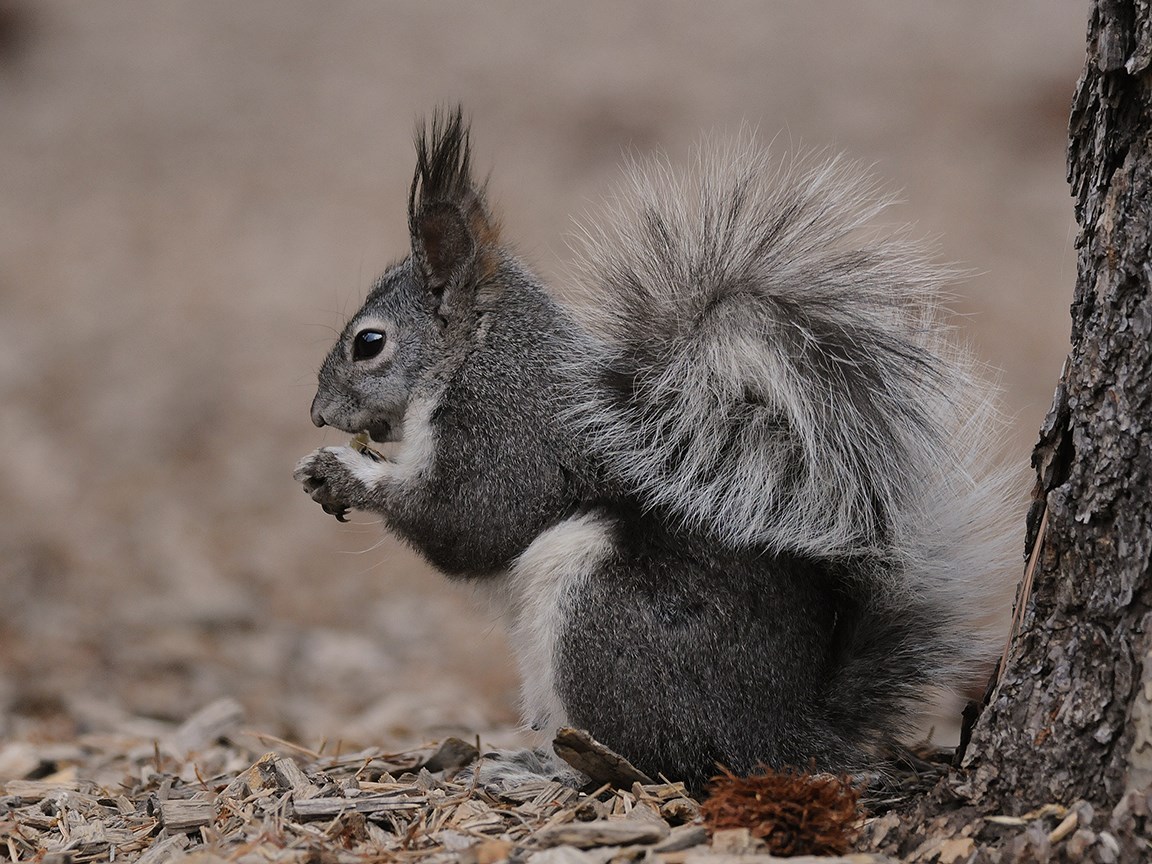
One of my favorite canyon inhabitants is the Abert’s squirrel. It’s long tufted ears and luxuriant bushy tail are distinctive and also very cute. I take great delight watching it scurry and scamper. I have seen it in lots of places, but it favors the ponderosa pines which are its shelter and its food source.
Abert’s squirrel (NPS photo by Sally King)
Slow going has been more fun and more interesting than I thought. Give it a try sometime – you might like it!
I have a long-standing affection for hiking, backpacking, and exploring the natural world on foot and independently. I also am a big fan of the National Park system and all the opportunities and experiences it offers. When setting out for adventure, it was my habit to find the most challenging trail, destination, or activity and make sure I conquered it – the tougher the better. I was dismissive of paved trails, easy hikes, and car camping. But, once I had a family, I realized (through frustrating and tearful trial and error) that maybe there was some merit to campgrounds with facilities and came to understand those easy trails were a perfect way to introduce little ones to things I cherished. Of course, kids got older. Things went back to being more challenging. And I went back to trying to be 20-something though I could plainly see that I was not. Even now, I overlook injuries, surgeries, natural aging, and my status as a plump, cookie baking Grandma.
Which is exactly how I got into trouble in Zion National Park, Utah just prior to my time here in Bandelier. I made the rookie mistake of overestimating my capabilities. I hadn’t planned on a hike but we came to a trailhead that I remembered and knew led to a spectacular view. I had optimism. I didn’t have hiking boots. I didn’t think about an unstable ankle. I didn’t calculate the change in elevation over a relatively short distance. I did have trekking poles and a hat. I figured that was enough. It wasn’t. I took a nasty tumble. I injured that already unstable ankle. I severely inflamed my patellar tendon. I got some spectacular bruises from all the rocks. But, as I painfully made my way down the trail, I realized that what I had been trying to do was maintain the idea of being “outdoorsy.”
That idea is based in large measure on what we are told and shown the ideal outdoorsy person is – young, able-bodied, athletic, lean, tanned, adventurous, and never ever content with being average. We are inundated with messages about these people. They live in tents and wear water sandals or hiking boots. They have the latest in outdoor gear and gadgets. They drive Subarus and shop at REI. They have obedient dogs that wear bandanas and backpacks. They plan wilderness treks and white water rafting trips. They have the luxury of leisure time. They are not too skinny and certainly never fat. They are never old and never wrinkled. They are mostly white. These messages leave very little room for all the rest of us, which is most of us. And, sometimes these messages create real barriers. For example, as a plump cookie-baking Grandma who also likes to hike and camp, it can be really hard to find good outdoor clothing that fits. Many outfitters don’t carry plus-sizes, and the ones that do tend to relegate it to one or two racks back in a corner with very few options. Regrettably, sales staff can be dismissive of people who are older or disabled. It can be embarrassing and sometimes discouraging. But–
–don’t give up or give in to unrealistic ideas or expectations! It’s good to know your limits, but don’t think that just because you can’t do everything you can’t do anything. That’s not true! If you love the outdoors, speak up for your needs and wishes. Ask for clothing that fits. Support accessibility options. Look for places that match your capabilities – there are lots of levels of difficulty, from wheelchair accessible to rugged wilderness. Don’t be afraid to hit the trail (or the hiking path or a stroll around the park) – here at Bandelier I have seen people of all ages, abilities, genders, colors and cultures out and enjoying this wonderful place. You don’t need a lot of money – a good pair of shoes or boots, a hat, and clothing that offers sun protection can be enough. Look for places you can fit into your time and your budget. You don’t have to go far. National, state, and local parks, forests, lakes, rivers and other recreation areas are closer than you think, and often budget friendly.
Be wise. Learn from my mistake. Try not to get into trouble in Zion or anywhere else. If you see me out and about, stop and say hello.
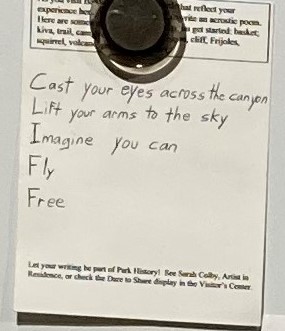
The Artist-in-Residence program gives visitors to Bandelier a chance to meet and engage with different kinds of artists. Today I had the opportunity to teach some mini writing workshops here in the park. I enjoyed having the chance to share my craft and encourage participants to use writing as a way to connect with this wonderful place. But, the AiR program is not the only chance people have to connect with something new or different. One thing Bandelier does really well is engage with local Pueblo communities and invite them to come here and share their history and culture with us. These are called cultural demonstrations and they are very interesting. They help visitors connect modern pueblo cultures with the ancient Tyuonyi (pronounced QU-weh-nee) culture that lived here in Bandelier through traditions that have been passed down intact over centuries.
Tyuonyi Village, Bandelier National Monument (Photo by Sally King, courtesy of NPS)
Over Labor Day I had the delightful opportunity to get to know two lovely people from the pueblo of Santo Domingo, Harvey Ross Abeyta and his wife Priscilla Nieto. Harvey is a flintknapper. He works with obsidian, chert, and agate which he collects himself, often from sources that were used by the early inhabitants of Bandelier and other ancestors of his tribe. He knew from an early age that he wanted to learn this traditional art. Though he is a master flintknapper, there is always someone that can teach him something new and he enjoys the challenge of learning.
Tools and raw materialsHarvey with a completed knife blade made out of smokey obsidian. (I had a great video of Harvey actually making this but I can’t get it to load…)Priscilla with some of her jewelry
Priscilla makes beautiful jewelry. She learned this art from her mother and has passed it on to her daughter. She does a lot of work with turquoise and can tell just by looking not only what kind of turquoise a stone is, but also which specific mine it came from. I learned that turquoise is primarily a by-product of mining ore. Green turquoise comes from copper mines and blue from silver mines. Priscilla is a prize-winning artist, including a Best of Show from the prestigious Crazy Horse pow-wow.
Close-up of necklaces, including some very fine inlay pieces
My time with Harvey and Priscilla was rewarding and informative. I learned many things about their families, including tribal leadership, US military service, and some of their traditions. I also came to understand that there are many thing that I will never learn because they are considered sacred and not shared outside of the community. Perhaps this is why the traditions and practices continue to bind this culture to its roots with an unbroken thread.
For information about upcoming Cultural Demonstrations in Bandelier National Monument, please visit their website: https://www.nps.gov/band/index.htm
Bandelier has a research library! It is small but full of all sorts of books on lots of topics such as Bandelier, archaeology, park history, natural history, human history, New Mexico, Pueblo cultures, children’s books, fiction, poetry, and others. I was hoping to find something about my grandmother. I did not, but I did borrow a few of the books. And, while I was there, I took the time to compose a few book spine poems. Please enjoy 🙂
The purpose of the Artist in Residence program here at Bandelier is to give artists, in my case a creative writer, the chance to pursue their craft in the unique environment of this canyon. There is much to experience here. Exploring the park and neighboring points of interest, talking with visitors, and learning from the Rangers are quite fun and very interesting. They are providing me with a lot of material for what I hope will one day be wonderful poems.
One of the things I am doing while I am here is refining a manuscript of poems that reflect my experiences as a military wife and mother. The horizontal spaces in my cozy casita – stools, fireplace hearth, dresser – are covered with poems in various stages of pondering, editing, and arranging.
The table, which is my desk, has everything else – computer, journal, reference material, and a notebook of poems-to-be inspired by my time here. It is a remarkable opportunity to immerse myself in the creative process (many thanks to my husband, who is at home making sure the cat is fed, the garden is watered and the bills are paid – you are the best!).
But, even in the midst of focused effort, there are moments when I do nothing but sit and watch the evening sun retreat up the canyon wall, listening as the sounds of the day quiet into blue dusk.
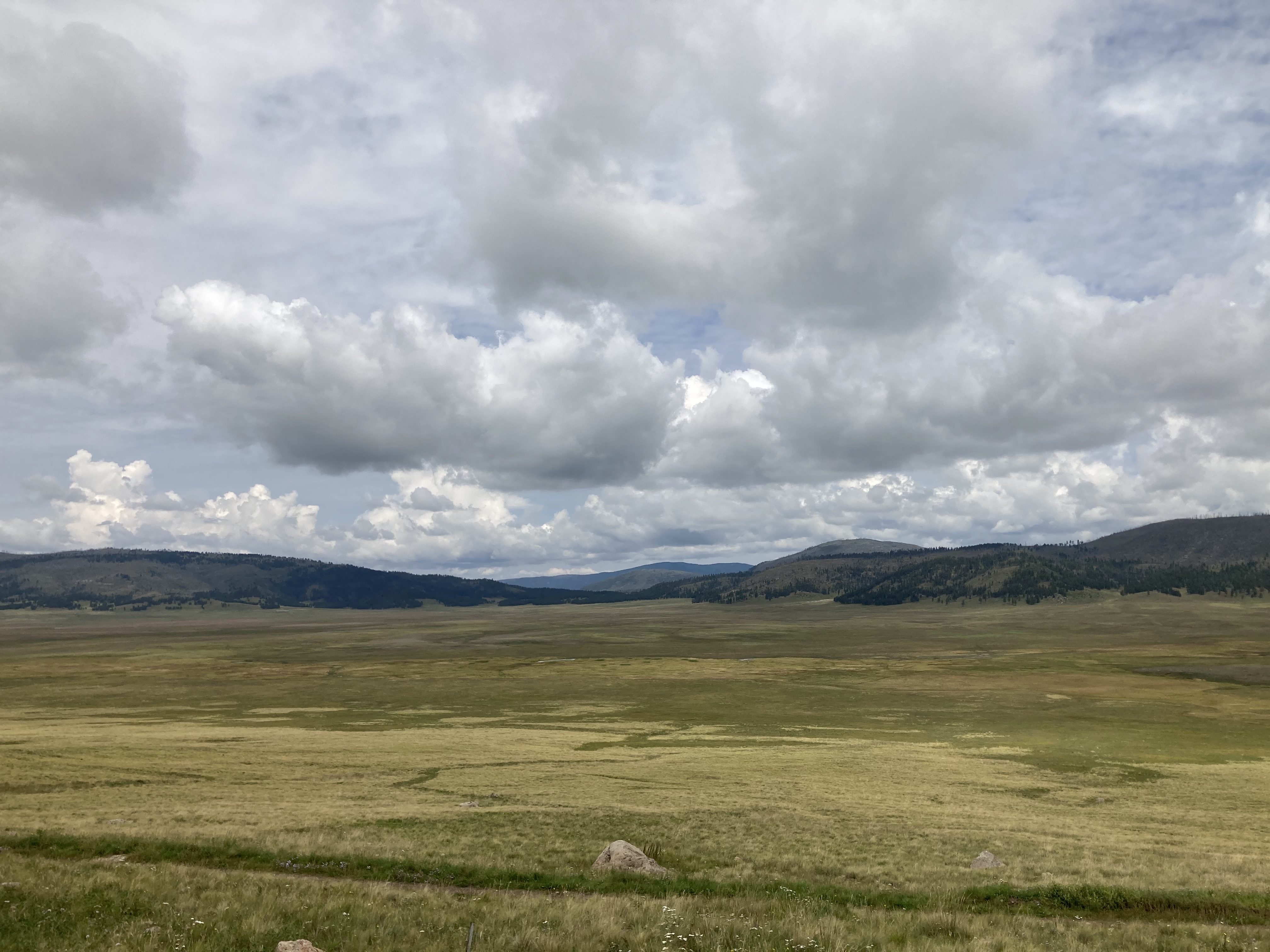
Frijoles Canyon, which is part of the Pajarito Plateau, was formed by an enormous volcanic eruption about 1.25 million years ago. The ash and cinders from this eruption have been found in Kansas, Texas, and other states, travelling as far East as the Mississippi River. Following the eruption, the volcano collapsed inward, creating a circular depression which is known as the Valles Caldera, now a national preserve. The caldera is 14 miles across, and is comprised of grassland meadows and rounded, forested volcanic domes. The stunning landscape is home to many plants and animals, from prairie dogs and pikas to elk, mountain lions, bears and coyotes.
Satellite image of Valles Caldera (courtesy of NASA – I didn’t take this one myself…)
Today I had the chance to visit the caldera, as well as travel some backroads above Bandelier, with photographer David Halpern, who knows the area well. It was a great day – warm weather, puffy clouds, stunning views.
The East Jemez, Valles CalderaMeadow and mountains, Valles CalderaNational Forest land above Bandelier.Looking South all the way to the Sandia mountains
I am sure there are poems waiting to be written about all the wonders I encountered today. Thanks David, for a great tour of places I may not have seen without you!
Where were you when the towers came down? That’s a common question on this date. I was on the floor of our quarters in Mannheim, Germany, my husband stateside for required Army training as I scrunched against the couch, arm clutching our dog to my side as I watched the events unfolding on TV. It seemed so incomprehensible, and yet there it was. And there I was, sorrowed and uncertain about what had just been unleashed.
I had a similar experience today as I visited Los Alamos, a key site of the Manhattan Project which resulted in the development (and the eventual deployment) of the first nuclear weapon. I am a child of the Atomic Age. I grew up with air raid drills and the threat of a nuclear winter. I know about the Enola Gay, have seen the films that show the bombing of Hiroshima and Nagasaki. But, until today, I had never seen what those bombs, Fat Man and Little Boy, actually looked like.
A full-scale replica of Little Boy on display in the Bradbury Science Museum, Los Alamos, New Mexico.
Little Boy, the bomb that was dropped on Hiroshima on August 6th, 1945, was 120 inches long and 29 inches in diameter. Other than it’s weight (9,700 lbs.), it could fit into a cargo van. I expected it to be bigger, to look more ferocious. It is hard to fathom that this was the cause of such catastrophic destruction.
After falling from the Enola Gay for 43 seconds, Little Boy detonates 1,968 feet above Hiroshima, 550 feet from the Aioi Bridge. Nuclear fission begins in 0.15 microseconds.
0916:03 (8:16:03am in Hiroshima, one second after detonation)- The fireball reaches maximum size, 900 feet in diameter. The mushroom cloud begins to form. As temperatures on the ground reach 7,000 degrees Fahrenheit, buildings melt and fuse together, human and animal tissue is vaporized. The blast wave travels at 984 miles per hour in all directions, demolishing over two-thirds of Hiroshima’s buildings in a massive, expanding firestorm. 80,000 people are instantly killed or grievously wounded. Over 100,000 more will die from the bomb’s effects in the coming months.
This seems so incomprehensible. Once again, I am sorrowed and uncertain about what we are capable of unleashing. I understand that human nature leads us to conflict, that there are real dangers, and real enemies that aggressively seek to destroy. Defense is a necessity. But I also understand that war is a terrible game we play with human lives, terms like “acceptable loss” and “collateral damage” linguistic masks for the unspeakable. I long for the day when we can move beyond our inclinations to harm one another, when [we] shall beat [our]swords into plowshares, and [our] spears into pruning hooks: nation shall not lift up sword against nation, neither shall [we] learn war any more. (Isaiah 2:4). That day may be a long way off. Perhaps it will never come. But it just might be possible, and so I will continue to hope.
This weekend my brother Dan and his wife Linda came to visit me here in Bandelier (sorry Linda – I didn’t get a picture of us).
My brother and I at the Tyuonyi village, in front of the cliff dwellings.
Dan and I haven’t been here together for decades – I think I was about nine and he was three. Before we moved to Colorado, our family came here often because, as I mentioned in an earlier post, my family has ties to Frijoles Canyon and Bandelier. My grandmother’s first husband was Edgar Rogers, the first park custodian assigned to Bandelier in June of 1932. She lived here with him in small, primitive quarters and served as an Honorary Custodian Without Pay. That means exactly what it sounds like – this was an unofficial park designation often extended to wives of official custodians – we call them rangers today – who worked at a variety of jobs in the parks for free. Despite the lack of remuneration, she relished this role. She quickly became acquainted with Eva Frey who operated the lodge here in the canyon, enjoyed her developing friendships with park employees, and learned all she could about the history, flora and fauna of the canyon. One of her favorite duties was leading guided tours of the ruins.
Gay Cook Rogers, circa 1933, in a park uniform
In the fall of 1933, Edgar died by suicide. Gay remained for a time at Bandelier, taking over many of Edgar’s duties. After Gay left Bandelier she returned often to visit Eva who became a life-long friend.
My grandfather, Richard Lovald, is the man in the rocking chair on the left. My grandmother is on the far left, and the baby she is holding is my mother. This is the Bandelier Lodge courtyard around 1938. This photograph was later used in a promotional brochure in the early 1940’s.
It followed naturally that we would make Bandelier a regular destination, staying in the lodge or camping across the creek. Eva, her head tilted just a bit to the side, would greet me as if I were a proper adult guest which made me feel very important. In the mornings while it was still cool, my father would walk with me to the ruins. Sometimes my grandmother would come too, and explain what I was seeing and why it mattered.
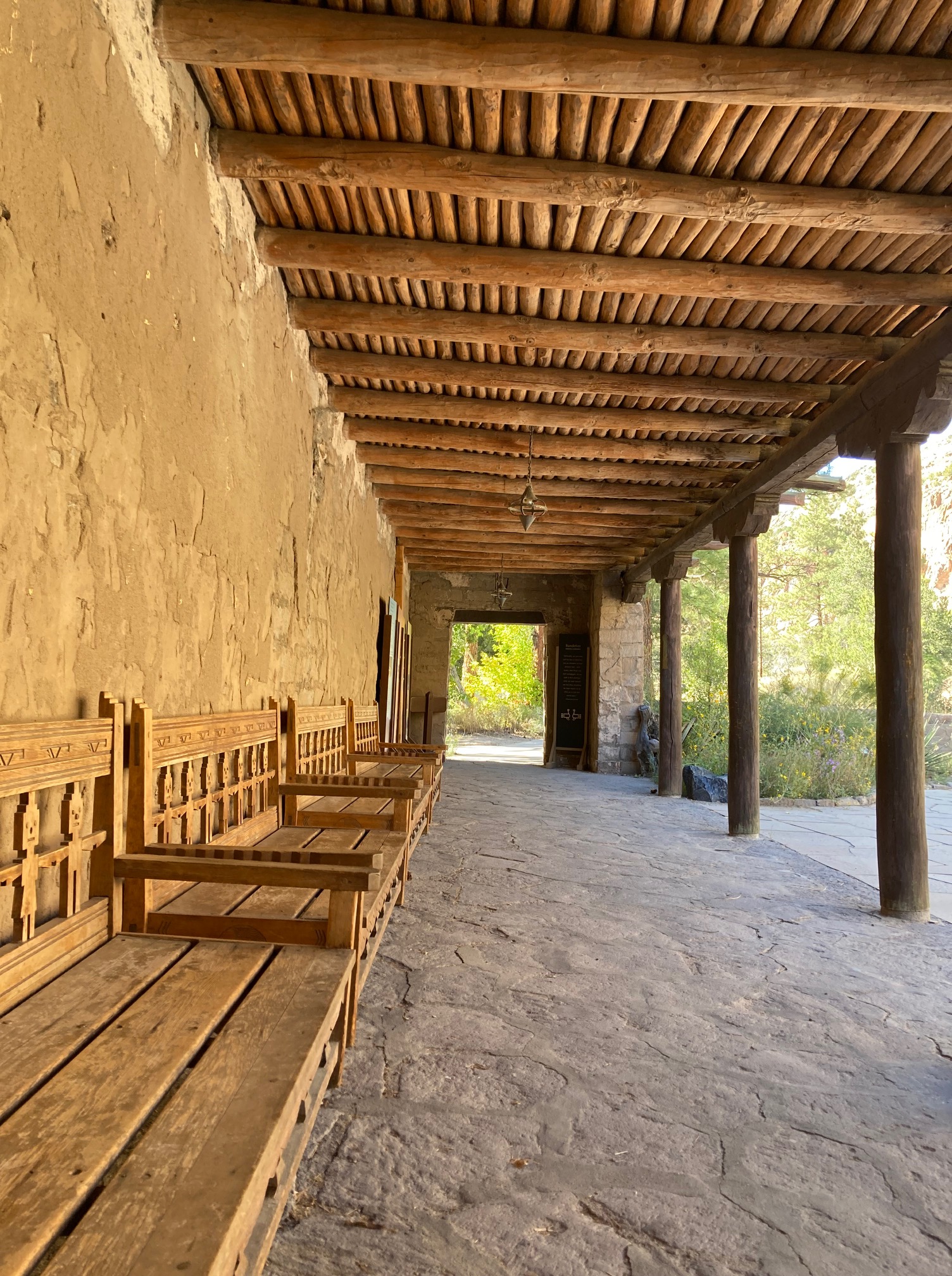
Though the lodge is no longer open to the public, the structures have been carefully preserved and look much the same as they did when I was small. So too, the ruins have changed little, except for some further excavation and constant preservation measures against erosion and many visitors. Being here is a step back in time. In moments of quiet reflection, I can hear Eva’s voice welcoming us to this space between honeycombed canyon walls, the fresh evening breeze cooling the lodge room in summer, or logs burning in the curved adobe fireplace filling it with warmth and the spice of pinon in winter.
Fires are no longer allowed in the rooms. Other than my brother, the people who made this place feel like home are no longer with me. I like to think they still visit here though, conversing with the Ancient Ones, their voices a gentle murmur slipping through the window screens as I drift off to sleep.
More information about Honorary Custodians Without Pay can be found in this excellent article: https://www.nps.gov/articles/000/two-for-the-price-of-one.htm, where I learned much more about this harrowing time in my grandmother’s life than she ever shared.
Photo of Gay Cook Rogers courtesy of author’s family collection
Lodge photo courtesy of Bandelier NPS archives. Link to the Bandelier CCC Historic District brochure, which has wonderful information about the lodge and the work of the CCC here: http://npshistory.com/brochures/band/ccc-walking-tour.pdf
I realize the tag on this site says “Dispatches From A Writing Life” which is a very idyllic-sounding sort of life to have. I also realize I have said very little about it, so here is a peek.
One of the ways I process experiences is to write them down in a journal. Sometimes my journal entries are clever and witty. Sometimes they are contemplative or insightful. Mostly they are things like what I had for lunch. But, whatever I manage to get on the page, the important thing is that I write something (I wish I had been writing the cost for a gallon of gas with each fill-up since January – that would be interesting).
When I arrived in Bandelier I was delighted to find a picnic table just outside my casita.
THIS, I thought, is a perfect place to write! It has a bit of shade and a lovely view of the canyon walls rising above the structures of the historic lodge. At sunset the escarpments, burnished with the last light of the day, are a rich ochre hue. At my first opportunity, which was after a very busy two days of orientation, meeting lots of new people, and stocking up on groceries, I was ready to relax into what would be my new ritual. I changed from hiking boots to flipflops. I gathered up my journal, my pen, and a fresh, ripe peach, traversed the few feet to the table, and sat where I had a perfect view of the sun-brushed cliffs. Yes! I said to myself, This is the writing life! And it was, except for one small detail….
…
…
…
Not this kind
THIS kind
They made it readily apparent that I was most UNwelcome. So now, my pen, my journal, and my peach join me at the end of each day as I write from the confines of my casita, screened windows and door open to the evening, but not the ants.